 iVIGA Faucet Manufacturer & Factory

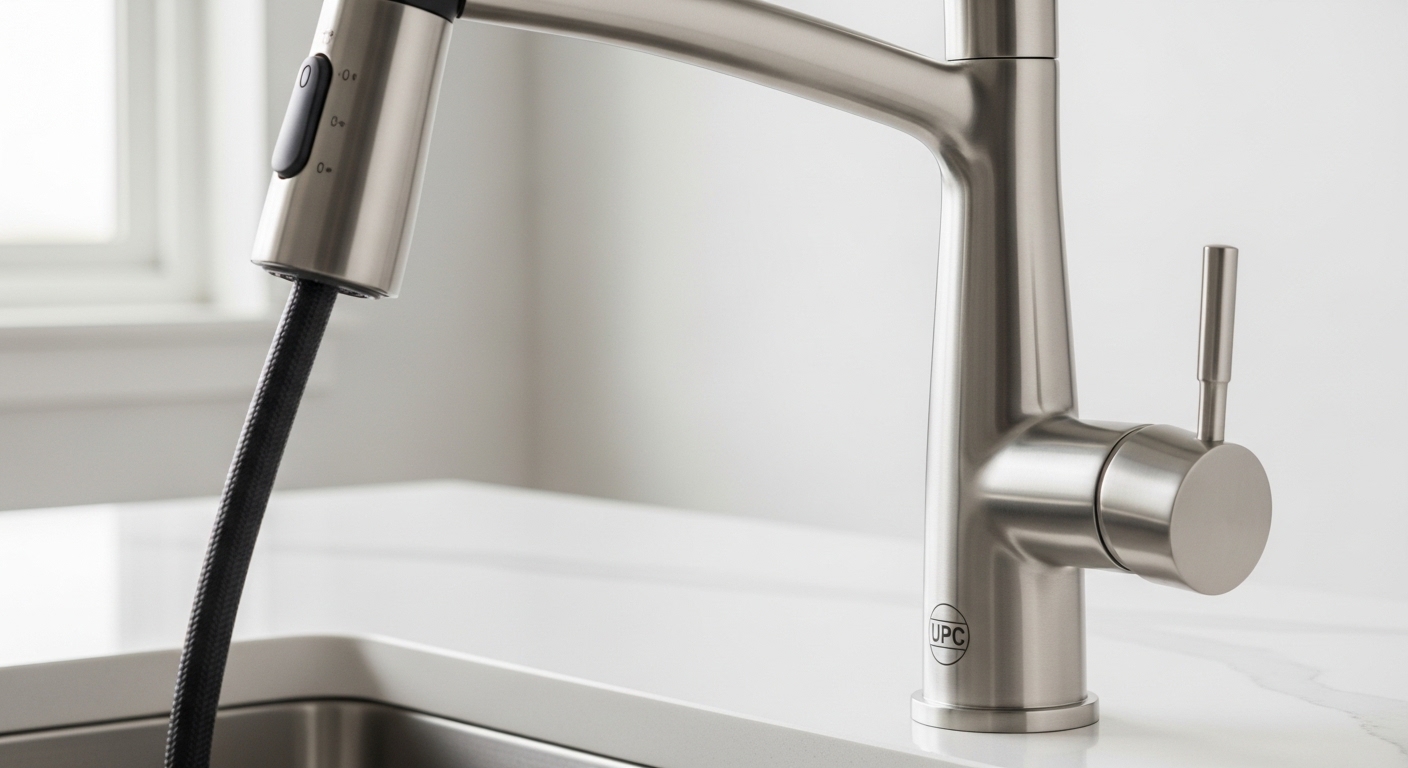
If you have been shopping for a new fixture, you have probably seen the term kitchen faucet UPC stamped on spec sheets, listing pages, or the box itself — and wondered whether it actually matters. It does. UPC stands for the Uniform Plumbing Code, and a UPC-certified kitchen faucet is one that an accredited third-party laboratory has tested against strict standards for water safety, pressure performance, material quality, and lead content. In most of the United States and Canada, that certification is not a marketing nicety. It is a requirement for the faucet to legally pass plumbing inspection.
Whether you are a homeowner replacing a worn-out fixture, a contractor outfitting a remodel, or a wholesale buyer placing a container order, understanding the kitchen faucet UPC mark protects you from costly mistakes. This article breaks down exactly what the certification means, what it tests, how to confirm a product really carries it, and what to look for when sourcing compliant faucets at scale.
What Does “Kitchen Faucet UPC” Actually Mean?
The phrase kitchen faucet UPC refers to certification under the Uniform Plumbing Code, a model code developed and maintained by IAPMO — the International Association of Plumbing and Mechanical Officials. The UPC is one of the most widely adopted plumbing codes in North America. When a faucet is “UPC listed” or “UPC certified,” it has been evaluated and approved through IAPMO R&T, the testing and certification arm of the organization.
A UPC-certified kitchen faucet has demonstrated compliance with the relevant consensus standards, most commonly ASME A112.18.1 / CSA B125.1, which governs plumbing supply fittings. Certification is not a one-time paperwork exercise either. Manufacturers must pass initial product testing and then submit to ongoing factory audits and periodic retesting, so the mark reflects continued conformance, not just a single lucky sample.
UPC vs. cUPC vs. NSF: Clearing Up the Confusion
Buyers often see several acronyms used interchangeably, but they are not identical. Here is the practical distinction:
- UPC — Certification recognized for compliance with the Uniform Plumbing Code, used primarily in the United States.
- cUPC — The same certification extended for Canada (the lowercase “c” denotes Canadian recognition). A cUPC mark covers both the U.S. and Canadian markets, which is why most reputable manufacturers pursue it.
- NSF/ANSI 61 & 372 — Standards focused specifically on drinking water system components and lead content. UPC/cUPC certification incorporates these lead-free requirements, so a properly certified faucet already addresses NSF 372 “lead-free” compliance.
For practical purposes, when someone asks for a kitchen faucet UPC certification, they almost always mean a cUPC-listed fixture that is legal to install across North America. If you sell into both markets, cUPC is the mark to insist on.
Why UPC Certification Matters for Your Kitchen Faucet
It is tempting to treat certification as bureaucratic overhead, especially when uncertified faucets are often cheaper. But the kitchen faucet UPC mark exists because the faucet is a direct point of contact between municipal water and the food you prepare. Here is what is genuinely at stake.
Lead-Free Water Safety
The single most important reason for UPC certification is health. Certified faucets must meet the federal “lead-free” definition — a weighted average lead content of no more than 0.25% across wetted surfaces. Older brass alloys could contain several percent lead, which leaches into standing water. A UPC-certified kitchen faucet uses low-lead brass or comparable wetted materials and is tested to prove the water passing through it is safe to drink. If your fixture supplies water for cooking, coffee, or filling a glass, this is non-negotiable.
Passing Inspection and Protecting Your Warranty
In jurisdictions that adopt the UPC, a plumbing inspector can fail a remodel or new build if the installed faucet is not listed. That means torn-out work, reorders, and schedule delays. For contractors and wholesale buyers, an uncertified shipment can become an expensive liability. Many manufacturer and installer warranties also become void if a non-compliant fixture is installed where code requires certification.
Durability and Performance You Can Trust
UPC testing is not only about lead. The standard verifies that the faucet withstands rated water pressure without leaking, that the cartridge endures tens of thousands of operating cycles, that the finish resists corrosion, and that the spout and aerator deliver flow within code limits. In other words, the kitchen faucet UPC mark is also a proxy for build quality — a faucet that survives this testing is far less likely to drip, seize, or corrode within a year.
How to Verify a Kitchen Faucet Is Genuinely UPC Certified
Unfortunately, some sellers print certification logos without holding a valid listing. Protect yourself by verifying rather than trusting the label. Here is a reliable process:
- Ask for the listing number. A real cUPC certification has a file or listing number tied to the manufacturer and specific product family.
- Search the IAPMO database. IAPMO publishes a public product listing directory. Enter the manufacturer name or listing number and confirm the kitchen faucet model is actually shown.
- Request the certificate. Legitimate manufacturers can provide the official certification document on request, including the standards covered and the expiration or audit date.
- Check the wetted-material declaration. The documentation should specify low-lead brass, stainless steel, or other compliant materials for all water-contact components.
- Confirm the scope. Certification covers specific models or series — not an entire catalog automatically. Make sure the exact SKU you are buying is within the listed scope.
If a supplier cannot produce a listing number or points you to a logo image with no documentation behind it, treat the kitchen faucet UPC claim as unverified.
UPC-Certified vs. Non-Certified Kitchen Faucets: A Side-by-Side Comparison
The table below summarizes the practical differences buyers should weigh before committing to an order.
| Factor | UPC / cUPC Certified Kitchen Faucet | Non-Certified Kitchen Faucet |
|---|---|---|
| Lead content | ≤ 0.25% weighted average, tested and verified | Unknown; may exceed safe limits |
| Code compliance | Passes plumbing inspection in UPC jurisdictions | May be rejected by inspectors |
| Third-party testing | Pressure, cycle, corrosion, and material testing | Self-declared or none |
| Ongoing audits | Periodic factory surveillance and retesting | No oversight |
| Resale & export | Accepted by North American distributors and retailers | Hard to place with reputable buyers |
| Upfront cost | Slightly higher | Lower — but higher total risk |
| Long-term value | Fewer failures, protected warranty, smoother projects | Replacement, rework, and liability exposure |
The headline takeaway: a non-certified faucet may save a few dollars per unit, but the kitchen faucet UPC mark eliminates a category of risk that is far more expensive to absorb later.
UPC-Certified Materials and Construction: What’s Inside
Certification is ultimately a reflection of how the faucet is built. A kitchen faucet that passes UPC testing usually shares these construction features:
- Low-lead brass body — Cast from compliant alloys for the spout, body, and waterways. Brass remains the gold standard for durability and machinability; we explore why in our article on why crucial plumbing components are made of brass.
- Ceramic disc cartridge — Rated for at least 500,000 open-close cycles in many certified products, delivering drip-free performance for years.
- Lead-free or stainless waterways — Some faucets use an integrated PEX or stainless waterway so water never touches brass at all.
- Corrosion-resistant finish — PVD or electroplated finishes tested for salt-spray and abrasion resistance.
- Code-compliant aerator — Flow rate held within the limit defined by local code, typically 1.8 GPM or lower for kitchen faucets in many regions.
- Certified supply lines and mounting hardware — The connectors and hoses are part of the listed assembly, not an afterthought.
If you are comparing how these features map to regional expectations, our guide to North American faucets covers the styles and finishes that pair naturally with cUPC compliance.
Sourcing UPC-Certified Kitchen Faucets Wholesale
For distributors, builders, and e-commerce sellers, the kitchen faucet UPC question becomes a sourcing strategy. Buying certified product at volume requires a manufacturer that treats certification as a standing capability, not a one-off favor.
When you evaluate a factory, confirm that certification is held under the manufacturer’s own name, that the listed product families match what you intend to order, and that the factory has passed recent surveillance audits. Ask whether private-label and OEM orders remain within the certified scope — a reputable partner can extend their listing to your branded SKUs rather than leaving them uncertified. If you produce custom designs, read our overview of the benefits of OEM faucets to understand how certification carries through a private-label program.
It is also worth noting that many home kitchens now adopt commercial-grade fixtures precisely because they are built to stricter standards — a trend we cover in why commercial faucets are chosen by home kitchens. A UPC-certified commercial-style kitchen faucet gives residential buyers both the look and the verified safety they want.
Questions to Ask Before Placing an Order
- Can you provide the IAPMO listing number for the exact model?
- Does the certification cover cUPC (U.S. and Canada) or U.S.-only?
- Are the supply hoses and mounting hardware part of the listed assembly?
- What is the cartridge cycle rating, and is it independently verified?
- Will my OEM/private-label SKUs be added to your certified scope?
- What warranty backs the certified product, and what voids it?
FAQ
Is a UPC-certified kitchen faucet legally required?
It depends on your jurisdiction. Many U.S. states and Canadian provinces adopt the Uniform Plumbing Code, and in those areas the inspector can require that installed faucets be UPC or cUPC listed. Even where it is not strictly mandated, the lead-free requirement under federal law still applies to faucets that deliver water for human consumption — and UPC certification is the most common way to demonstrate it.
What is the difference between UPC and cUPC for a kitchen faucet?
They are the same certification program; the lowercase “c” simply indicates the listing is recognized in Canada as well as the United States. A cUPC-marked kitchen faucet is approved for both markets, which is why most exporters and serious wholesale buyers ask for cUPC specifically rather than U.S.-only UPC.
How can I check if my kitchen faucet is really UPC certified?
Ask the seller for the IAPMO R&T listing number and look it up in the public IAPMO product directory. Confirm that the specific model appears under the manufacturer’s name. A printed logo alone is not proof — only an active listing tied to your exact SKU is.
Does UPC certification cover lead content?
Yes. UPC/cUPC certification for kitchen faucets incorporates the lead-free standards, requiring a weighted average of no more than 0.25% lead across all wetted surfaces. That is one of the core reasons the certification exists, since the kitchen faucet is a direct contact point for drinking and cooking water.
Are UPC-certified kitchen faucets more expensive?
Usually a little, because they use compliant low-lead materials, certified cartridges, and undergo third-party testing plus ongoing audits. However, the price gap is small compared to the cost of failing inspection, voiding a warranty, or replacing a faucet that corrodes early. Over the life of the fixture, certified product is typically the lower-cost choice.
Can custom or OEM kitchen faucets still be UPC certified?
Yes. A manufacturer that holds a certification listing can extend it to private-label and OEM SKUs as long as the design stays within the tested parameters. Always confirm in writing that your branded models are included in the certified scope before production begins.
Author Note & Brand Credibility
Written by the VIGA product content team, drawing on input from our engineering and quality-assurance staff who manage faucet certification submissions and factory audits. VIGA is a faucet manufacturer based in Kaiping, China — a region long recognized as a center of faucet production — with years of experience supplying OEM and ODM fixtures to North American and global markets.
Our kitchen faucets are produced with low-lead brass and ceramic disc cartridges, and our certified product families are tested to ASME A112.18.1 / CSA B125.1 with cUPC listings maintained through IAPMO R&T, including periodic surveillance audits of our facility. Every certified faucet is backed by a manufacturer warranty against material and finish defects under normal installation and use. To learn more about our certification capabilities and small-to-large order flexibility, visit VIGA, OEM and ODM faucet manufacturer in Kaiping, China.
WeChat
Scan the QR Code with WeChat