 iVIGA Faucet Manufacturer & Factory

If you’ve been searching for a centerset faucet delta model, you’re almost certainly staring at a bathroom sink with three holes drilled 4 inches apart and trying to figure out the smartest way to fill them. That’s the whole question, and it deserves a straight answer instead of a wall of marketing. Below, I’ll break down exactly what “centerset” means, where Delta genuinely earns its price, where it doesn’t, and how to compare a Delta centerset against a solid-brass alternative like iVIGA without getting lost in spec-sheet jargon.
What exactly is a centerset faucet, and why does “4 inch” keep coming up?
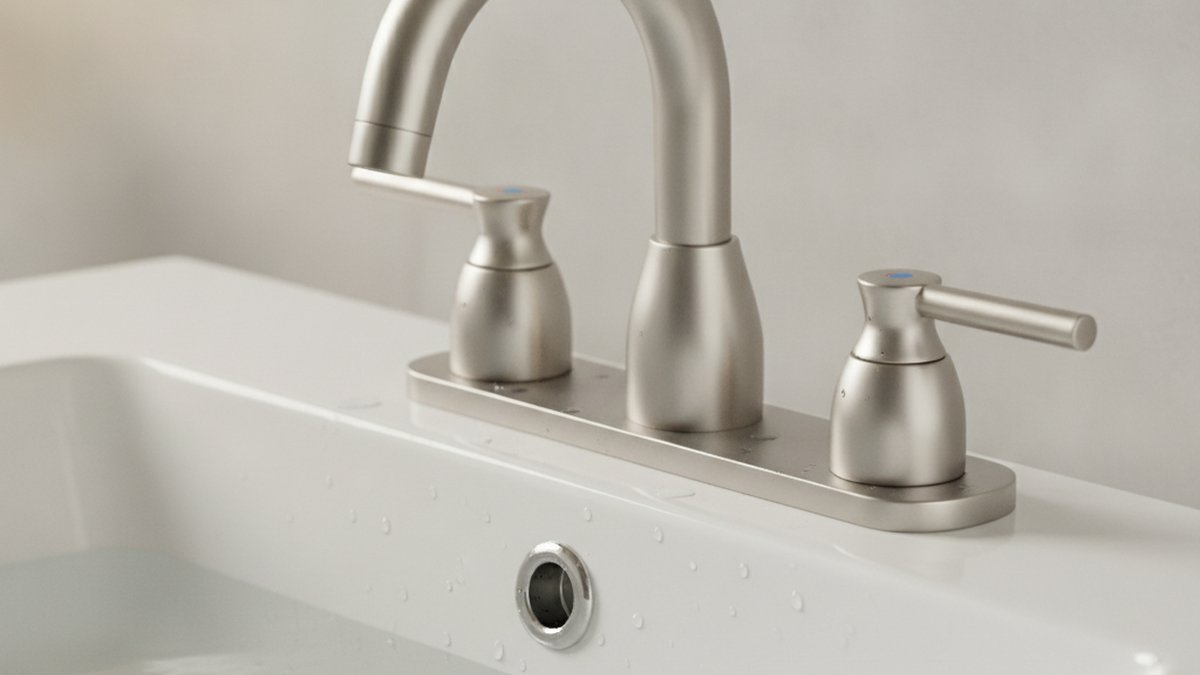
A centerset faucet is a bathroom faucet built for a sink with three holes spaced 4 inches apart, center-to-center, where the spout and both handles sit on one connected base plate (the escutcheon). That 4″ number is the entire reason the category exists — it’s the most common drilling on standard U.S. bathroom sinks, so a “4-inch centerset” drops straight in.
Here’s the part that trips people up. A centerset is not the same as a widespread faucet. On a widespread, the spout and two handles are three separate pieces spread 8–16 inches apart. On a centerset, they’re unified — either two handles on a shared plate, or a single-handle unit sitting on a base plate that covers all three holes. If your sink holes are 4 inches apart, you want a centerset. If they’re 8 inches apart, you want widespread. Measuring this before you buy anything saves a painful return; if you’re unsure how hole spacing works, our guide on getting the right faucet-to-sink spacing walks through measuring it properly.
- Centerset: 4″ hole spacing, unified base — the default for most bathrooms.
- Single-hole: one hole only, often sold with an optional deck plate to convert to a 3-hole look.
- Widespread: 8″+ spacing, three independent pieces — a more upscale, custom look.
- Mini-widespread: 4″ spacing but with the separated-piece look — a hybrid that fits centerset holes.
Is a Delta centerset faucet actually worth the price?
Yes — if you specifically value Delta’s parts network and lifetime warranty, and you’re okay paying for it. Delta’s real advantage isn’t the faucet itself; it’s the ecosystem behind it. A Delta cartridge is easy to source at any big-box store a decade from now, and their limited lifetime warranty covers finish and function for the original homeowner.
Where Delta shines specifically:
- DIAMOND™ seal ceramic-disc valves that are rated for long cycle counts and resist hard-water grit.
- Widely stocked replacement cartridges — you’ll never be hunting a discontinued part.
- Spot-Resist / brushed finishes that hide water spots on daily-use faucets.
- A genuine lifetime warranty that Delta actually honors with mailed-out parts.
Where the value gets thinner: you’re paying a brand premium, and a fair number of Delta’s lower and mid-tier centerset models use zinc-alloy bodies and plastic internal components to hit a price point, not solid brass. That’s not a scandal — it’s normal for the category — but it means the “Delta name” alone doesn’t guarantee an all-brass build. So the honest question isn’t “Is Delta good?” (it is), it’s “Am I paying for the badge, or for the build?”
How does an iVIGA centerset faucet compare to a Delta on a real sink?
On the sink, they install identically — both drop into the same 4-inch three-hole configuration, both use standard 3/8″ supply connections, and both should mount in under an hour. The difference is what’s inside and what you pay. iVIGA builds its bathroom faucets around solid-brass bodies and ceramic-disc cartridges, then prices them well under a comparable-tier Delta because you’re not paying for a century-old marketing budget.
Here’s a head-to-head on the specs that actually matter for a centerset:
| Spec | Typical Delta Centerset | iVIGA Centerset |
|---|---|---|
| Hole spacing | 4″ (3-hole) | 4″ (3-hole) |
| Body material | Brass or zinc-alloy (model-dependent) | Solid brass |
| Valve type | Ceramic disc (DIAMOND seal) | Ceramic disc |
| Flow rate | 1.2 GPM (WaterSense on many models) | 1.2–1.5 GPM |
| Certifications | cUPC, NSF 61, WaterSense | cUPC, NSF 61 |
| Warranty | Limited lifetime | Limited warranty (5+ yr typical) |
| Typical price tier | $$–$$$ | $–$$ |
| Parts availability | Any big-box store | Direct from brand |
The trade-off is clean and honest. Delta wins on walk-into-any-store parts availability and the lifetime warranty. iVIGA wins on solid-brass build at a lower price. If you’re the kind of person who might replace a cartridge yourself in 2035 and wants to grab it off a shelf that afternoon, Delta’s network is worth real money. If you’d rather order a matched replacement part when the rare need arises and keep $60–$120 in your pocket today, the alternative makes more sense.
What’s the difference between a single-handle and two-handle centerset faucet?
A single-handle centerset controls temperature and flow with one lever, so you set the water with one hand; a two-handle centerset gives you separate hot and cold controls for precise temperature and a more classic look. Both fit the same 4-inch holes, so this is purely about how you like to use the sink.
Quick decision guide:
- Choose single-handle if you want fast one-hand operation (great for kids, elderly users, or a busy powder room) and a cleaner, modern silhouette.
- Choose two-handle if you want exact temperature memory (“cold is always this far”), a traditional aesthetic, or you’re matching an older bathroom.
One practical note on two-handle models: because there are two cartridges, there are two possible drip points instead of one. It’s not a dealbreaker — ceramic-disc cartridges last years — but it’s worth knowing when a slow drip eventually shows up. If it does, our walkthrough on how to fix a faucet drip yourself uses the same cartridge-swap logic that applies to bathroom centersets.
Which finish should you pick for a centerset faucet?
For most bathrooms, brushed nickel is the safest, most forgiving finish because it hides water spots and fingerprints and matches nearly every fixture. Chrome is cheaper and brighter but shows every droplet; matte black and brushed gold are on-trend but demand a committed design direction. The finish is the thing your eye lands on every day, so it’s worth a beat of thought.
| Finish | Best for | Watch out for |
|---|---|---|
| Brushed / Spot-Resist nickel | Daily-use family baths — hides spots | Slightly warmer tone, won’t match pure-chrome fixtures |
| Polished chrome | Budget builds, bright classic look | Shows water spots and fingerprints fast |
| Matte black | Modern, high-contrast bathrooms | Shows limescale/dust; commit to the aesthetic |
| Brushed gold / champagne bronze | Warm, upscale statement vanities | Harder to match other fixtures, pricier |
If you’re leaning toward the most low-maintenance option, we make the full case for it in our deep-dive on why brushed nickel is such a forgiving finish — the same logic that applies to a shower valve applies to your centerset. And if you want to see how iVIGA stacks up against the big names before you commit to any brand, our roundup of the best bathroom faucet brands for 2026 puts the field side by side.
How do you install a 4-inch centerset faucet yourself?
You can install a centerset faucet in about 30–60 minutes with a basin wrench, plumber’s tape, and an adjustable wrench — no plumber required for a standard 3-hole swap. The unified base plate actually makes this easier than a widespread, because everything is pre-aligned on one piece.
- Shut off the water at the two supply valves under the sink and open the old faucet to drain the line.
- Disconnect and remove the old faucet — loosen the supply lines and the mounting nuts underneath, then lift it out and clean the deck.
- Set the new faucet onto the three holes; the escutcheon plate covers all of them. Use the included gasket or a bead of silicone under the base.
- Tighten the mounting nuts from below with a basin wrench — snug, not gorilla-tight, so you don’t crack the deck.
- Connect the supply lines with plumber’s tape on the threads, hand-tighten, then a quarter-turn with a wrench.
- Turn the water back on slowly, run both handles, and check every joint for drips. Tighten a hair more only if you see moisture.
The most common rookie mistake is over-tightening — either cracking a ceramic sink deck or stripping the plastic mounting nuts. Snug plus a quarter turn is the target. If you’re removing a stubborn old unit first, the same careful approach in our guide on removing an old faucet the right way keeps you from rounding off corroded nuts.
Centerset faucet buying checklist: what actually matters
Before you check out — whether it’s a Delta or an iVIGA — run through this. These are the specs that determine whether you’re happy in five years, not the ones on the front of the box.
- Confirm 4″ hole spacing. Measure center-to-center on your existing holes. This is non-negotiable.
- Insist on a ceramic-disc cartridge. Rubber-washer valves are cheaper but drip years sooner.
- Prefer a solid-brass body for corrosion resistance and longevity over zinc-alloy where you have the choice.
- Check for cUPC + NSF 61 certification. These confirm the faucet is lead-safe for drinking water and legal for U.S. installation — not optional.
- Look at the flow rate. 1.2 GPM is WaterSense-efficient; 1.5 GPM feels a touch stronger. Bathroom faucets don’t need more.
- Read the warranty terms, not just the length — “lifetime” that requires the original receipt is different from a transferable one.
That certification point matters more than most shoppers realize. The cUPC mark and NSF/ANSI 61 compliance are the standards that govern lead content and material safety in fixtures that touch potable water — reputable brands, iVIGA included, test to them. If you’re curious what those acronyms actually verify, our faucet certifications guide covering cUPC, NSF 61, CE and WRAS explains what each one guarantees so you can spot a corner-cutter.
So, Delta or an alternative — how do you actually decide?
Decide by answering one question: do you value the store-shelf parts network more than the price savings? If yes, buy the Delta centerset and enjoy the peace of mind. If the price savings and a solid-brass build matter more, an iVIGA centerset gives you the same 4-inch fit, the same ceramic-disc valve technology, and the same certifications for meaningfully less.
Neither choice is wrong. Delta is a genuinely good, safe default — nobody gets fired for buying one. But “safe default” and “best value for your specific bathroom” aren’t always the same faucet, and the whole point of shopping is to match the fixture to how you actually live. A centerset that fits your holes, uses a ceramic cartridge, carries a solid-brass body, and passes cUPC/NSF 61 will serve you for years whether the badge says Delta or iVIGA.
FAQ
Will a centerset faucet fit my bathroom sink?
It will if your sink has three holes spaced 4 inches apart, center-to-center — that’s the standard centerset configuration. Measure from the middle of the left hole to the middle of the right hole; if it’s roughly 4 inches, a centerset drops right in. If it’s 8 inches or more, you need a widespread faucet instead.
Is a Delta centerset faucet made of solid brass?
It depends on the model. Delta’s higher-end centersets use brass, but many mid- and lower-tier models use zinc-alloy bodies with plastic internals to hit a price point. Always check the product spec for “solid brass” rather than assuming the brand guarantees it — this is one area where a solid-brass alternative like iVIGA can actually outbuild a similarly priced Delta.
Can I replace a two-handle centerset with a single-handle one?
Yes, as long as the new single-handle faucet is designed for 4-inch centerset holes and comes with a base plate (escutcheon) that covers all three holes. Most single-handle centersets include exactly that plate, so you can switch from two handles to one without redrilling or replacing the sink.
How long does a centerset faucet last?
A quality centerset with a ceramic-disc cartridge and a brass body typically lasts 15–20 years, and often longer with the occasional cartridge swap. The cartridge is the wear part; when a drip finally appears, replacing that inexpensive component usually restores it rather than needing a whole new faucet.
Are cheaper centerset faucets safe to drink from?
Only if they carry cUPC and NSF/ANSI 61 certification, which verify the faucet’s wetted materials meet U.S. lead-safety limits for potable water. Price isn’t the indicator — certification is. A budget-friendly faucet that’s properly certified is safe; an uncertified one at any price is a gamble, so look for those marks before you buy.
Do I need a plumber to install a centerset faucet?
Usually not. A standard centerset swap into existing 4-inch holes takes 30–60 minutes with basic tools — shut off the supply valves, remove the old unit, set and secure the new one, and reconnect the lines. Call a plumber only if your shutoff valves are seized, the old faucet is badly corroded, or you’re changing the hole configuration.
Author note: Written by the iVIGA product team, who spec, pressure-test, and finish bathroom and kitchen faucets for a living. Every centerset we ship is cycle-tested at the cartridge and checked against cUPC and NSF/ANSI 61 standards before it’s packed. iVIGA has manufactured brass fixtures for over a decade for buyers across North America and Europe, and we back our faucets with a manufacturer’s warranty and direct replacement-part support. This guide reflects hands-on testing, not repackaged spec sheets — our goal is to help you buy the right faucet once.
WeChat
Scan the QR Code with WeChat