 iVIGA Faucet Manufacturer & Factory

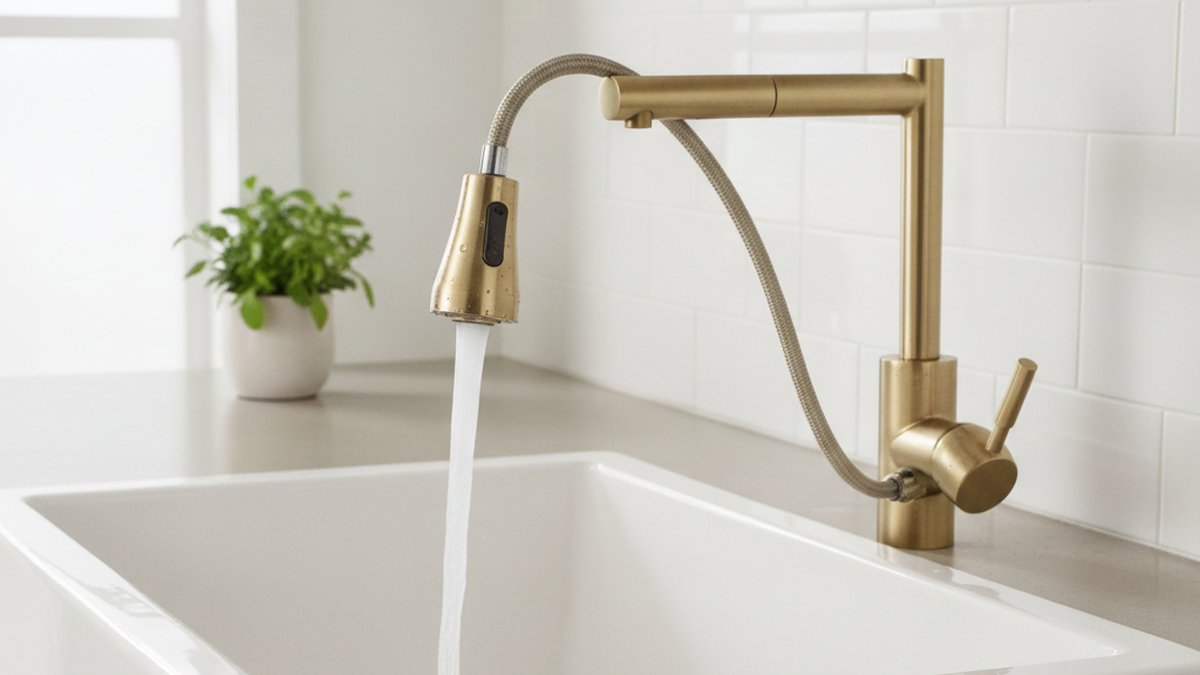
A pull out kitchen faucet brass build simply means the faucet body — the part water actually flows through — is made from solid brass rather than zinc alloy or plastic, paired with a spray head you pull straight out toward you on a flexible hose. That combination matters more than any finish or brand logo: brass resists corrosion, handles hot water and hard water without cracking, and holds threads tightly so the faucet doesn’t loosen or leak after a few years of daily use. If you cook every day, wash big pots, or live somewhere with mineral-heavy water, this is the spec worth paying for.
Below I’ll walk through exactly when brass is worth it, how to tell real brass from plated fakes, pull-out versus pull-down, what it should cost, and how to install one — the same questions I hear over and over from customers deciding between a $49 special and a faucet that’ll still work in 2040.
What does “pull out kitchen faucet brass” actually mean?
It’s two separate specs bundled into one search. “Pull out” describes the spray head, and “brass” describes the material of the body — and people conflate them all the time, so let’s separate them cleanly.
Pull-out refers to how the sprayer moves: you grip the spray head and pull it horizontally out of the spout on a flexible hose, usually 20–30 inches of travel. It’s different from a pull-down, where a taller gooseneck spout lets the head glide straight down into the sink. Pull-outs sit lower and closer to the sink, which is why they’re popular in kitchens with a window behind the faucet or with upper cabinets that limit height.
Brass refers to the alloy the waterway is cast from. Solid brass — typically a lead-safe alloy like C46500 or the low-lead brasses required for potable water — is heavy, dense, and naturally corrosion-resistant. When someone says “brass faucet,” they can mean two very different things: a faucet with a genuine brass body, or a cheaper faucet with a brass-colored finish (champagne bronze, brushed gold) plated over zinc. Those are not the same purchase, and knowing the difference is half the battle. If you’re still comparing spout shapes and layouts, our guide to the best kitchen tap design for your sink pairs well with this one.
Is a solid brass pull-out faucet really more durable than stainless or zinc?
Yes, in the ways that make a faucet fail. Brass resists internal corrosion and pitting far better than zinc alloy, and unlike plastic it won’t warp under hot water or crack at the threads. The most common cause of a leaking faucet after year three isn’t the finish — it’s the zinc body corroding from the inside out. Brass sidesteps that entirely.
Here’s the honest nuance: high-quality 304 stainless steel bodies are also excellent and genuinely rival brass for corrosion resistance. The problem is that “stainless-look” faucets are often stainless-finished zinc, the same trick as brass plating. Solid brass has one practical edge — it machines to tight, leak-free threads and holds a cartridge seat cleanly, which is why premium cartridges are almost always seated in brass. If you want the deeper materials comparison, we break it down in brass vs stainless steel faucet manufacturing.
What actually kills faucets, in order:
- Internal corrosion of a zinc body — the #1 long-term failure. Brass resists it.
- A worn cartridge — the wear part; on a good faucet it’s a $15 replaceable ceramic-disc cartridge, not a reason to junk the whole unit.
- A cracked or kinked hose on the pull-out spray — braided stainless or nylon hoses last; thin PVC ones split.
- Mineral scaling at the aerator — cosmetic and cleanable, not fatal.
Notice that brass fixes the worst one. That’s the whole value proposition. For a broader look at what separates a faucet that lasts from one that doesn’t, see our roundup of the best kitchen faucet for durable everyday use.
How do I tell real solid brass from brass-plated zinc before I buy?
The fastest tells are weight, price, and the product spec sheet — real brass is heavy, honestly priced, and the seller states the body material plainly. If a listing hides what the body is made of, assume it’s plated zinc.
Use this quick checklist when you’re comparing two similar-looking faucets:
- Read the spec, not the finish name. Look for “solid brass body” or “brass waterway.” “Brass finish,” “brass-colored,” or silence about the body usually means plated zinc.
- Pick it up. A solid brass pull-out faucet feels noticeably heavier and denser than a zinc one of the same size. Cheap faucets feel hollow.
- Check the price floor. A genuine solid brass pull-out with a ceramic cartridge realistically starts around $120. A $39 “brass” faucet is plated zinc — physics and material cost don’t allow otherwise.
- Look for certifications. cUPC / NSF-61 and (for low lead) NSF-372 compliance signal a manufacturer serious enough to use proper materials. See our faucet certifications guide for what each one actually verifies.
- Ask about lead content. Modern potable-water brass is low-lead (≤0.25% weighted average). A seller who can answer that question is selling real brass.
One myth worth killing: a magnet test doesn’t reliably prove brass. Neither brass nor stainless is strongly magnetic, and zinc isn’t either — so a magnet won’t distinguish them. Weight plus a stated spec is far more trustworthy.
Pull-out vs pull-down — which one is right for my kitchen?
Choose a pull-out if you have low clearance above the sink (a window, a shelf, or upper cabinets), a smaller sink, or you want to fill pots and buckets on the counter beside the sink. Choose a pull-down if you have a deep single-bowl sink and want maximum reach down into it with a tall, statement gooseneck. Both come in solid brass; the choice is about your space, not durability.
| Factor | Pull-Out Brass Faucet | Pull-Down Brass Faucet |
|---|---|---|
| Spout height | Lower (7–10 in typical) | Taller gooseneck (14–18 in) |
| Under-window / low-cabinet fit | Excellent | Often too tall |
| Spray head travel | Horizontal, 20–30 in of hose | Straight down into the bowl |
| Best for | Small sinks, filling counter pots, tight clearance | Deep single-bowl sinks, big cookware |
| Aesthetic | Lower profile, understated | Statement piece |
| Typical price (solid brass) | $120–$300 | $150–$350 |
A common real-world scenario: you have a window over the sink and a pull-down’s gooseneck won’t clear the sill. A brass pull-out solves that instantly while giving you the same reach — you just pull the head toward you instead of down. If you’re also rethinking sink and spacing, our piece on the right wide faucet sink setup covers hole spacing and layout.
What should a good brass pull-out kitchen faucet cost in 2026?
Budget $120–$350 for a genuine solid brass pull-out with a ceramic-disc cartridge and a braided hose. Below $120 you’re almost certainly buying plated zinc, and above $350 you’re mostly paying for a designer brand name rather than better internal engineering.
Here’s how the tiers break down in practice:
- $40–$80: Brass-plated zinc body, plastic spray head, PVC hose. Looks fine on day one; the body is the failure point in a few years.
- $120–$200: The sweet spot. Solid brass body, ceramic-disc cartridge (rated 500,000+ cycles), braided stainless hose, real metal spray head. This is where a pull out kitchen faucet brass build pays for itself.
- $200–$350: Solid brass plus premium finishes (PVD-coated brushed gold, matte black), magnetic dock for the spray head, and often a lifetime finish warranty.
- $350+: Prestige brands. You’re paying for design and marketing; the core mechanicals aren’t dramatically better than the mid tier.
One spec matters more than price: the cartridge. A ceramic-disc cartridge is what gives you smooth handle action and a drip-free life. A good brass body with a cheap rubber-washer cartridge will drip within a year — and if it does, don’t panic, our guide on how to fix a kitchen faucet drip walks you through the cartridge swap.
How hard is it to install a pull-out brass faucet myself?
Most people can install a brass pull-out in 45–90 minutes with a basin wrench, an adjustable wrench, and plumber’s tape — no plumber required for a standard single-hole or three-hole replacement. The heavier brass body is actually easier to seat squarely than a light one; it doesn’t wobble while you tighten.
The basic sequence:
- Shut off both supply valves under the sink and open the faucet to release pressure.
- Remove the old faucet. This is the fiddly part — corroded mounting nuts fight back. Our step-by-step on removing an old kitchen faucet the right way covers the stuck-nut tricks.
- Feed the new supply lines and pull-out hose down through the mounting hole, then set the faucet on its gasket and center it.
- Tighten the mounting nut from below with a basin wrench until snug — brass bodies stay put once seated.
- Connect the pull-out hose to the quick-connect fitting, then attach the hose weight (it’s what retracts the spray head).
- Connect supply lines with plumber’s tape, turn the water back on slowly, and check every joint for drips.
If your new faucet feels weak after installation, the cause is almost always a clogged aerator or a supply valve that isn’t fully open — not the faucet itself. The community-sourced fixes in our kitchen faucet low water pressure guide solve it in most cases.
Which finish holds up best on a brass pull-out faucet?
For daily durability, a PVD-coated finish — brushed nickel, brushed gold, or matte black — is the most scratch- and tarnish-resistant option, and it’s what I recommend for busy kitchens. Raw, unlacquered brass (the “living finish” that patinas over time) looks gorgeous but needs polishing to stay bright; go into it knowing it will darken.
Quick finish guide for brass bodies:
- Brushed nickel / stainless-look: hides water spots and fingerprints best; the safest all-round pick.
- Brushed gold / champagne bronze: warm, on-trend, and forgiving of smudges when brushed (not polished).
- Matte black: striking, but shows hard-water mineral spots faster — wipe it down.
- Chrome: cheapest, brightest, shows every fingerprint.
- Unlacquered / living brass: ages into a warm patina; for people who want character, not maintenance-free.
Whatever the finish, insist on PVD (physical vapor deposition) over standard electroplating — PVD bonds the color at a molecular level and typically carries a lifetime finish warranty, while cheap plating flakes at the spray-head grip within a couple of years.
Why iVIGA for a brass pull-out — and a note on how we tested this
iVIGA has manufactured faucets and bathroom fixtures for over 20 years, supplying both our own direct-to-consumer line at www.viga.cc and OEM/ODM clients worldwide. Our brass pull-out kitchen faucets use lead-safe solid brass bodies, ceramic-disc cartridges rated to 500,000 open-close cycles, and braided stainless hoses, and they’re tested to cUPC and NSF-61/372 standards for potable water safety. Our finishes carry a limited lifetime finish warranty and cartridges a 5-year functional warranty.
Author note: This guide was written by the iVIGA product content team, drawing on our factory QC data, cartridge cycle-testing, and the questions we field daily from customers and B2B buyers choosing between materials. We manufacture the products discussed here, so treat this as informed by hands-on experience — and cross-check the neutral specs (certifications, cartridge cycle ratings) against any faucet you’re considering, ours or otherwise.
FAQ
Is a brass pull-out kitchen faucet safe for drinking water?
Yes, as long as it’s low-lead brass certified to NSF-61 and NSF-372. Modern potable-water brass keeps the weighted-average lead content at or below 0.25%, which is the legal limit for drinking-water fixtures in the U.S. Always confirm the certification on the listing — a compliant faucet will state it plainly.
Will a brass faucet tarnish or turn green?
A finished brass faucet (PVD or electroplated) won’t tarnish or turn green — the finish seals the metal. Only raw, unlacquered “living finish” brass develops a patina, and even that is surface-level, not corrosion. If you want zero maintenance, choose a PVD brushed or matte finish rather than unlacquered brass.
How long does a solid brass pull-out faucet last?
A quality solid brass pull-out typically lasts 15–20+ years, with the ceramic cartridge being the only likely replacement along the way — usually a $15 part swapped in 15 minutes. The brass body itself rarely fails because it doesn’t corrode internally the way zinc does.
Is the pull-out hose the weak point on these faucets?
It can be on cheap models, but not on well-built ones. Look for a braided stainless-steel or reinforced nylon hose rather than thin PVC, and a quick-connect fitting so a replacement hose (if you ever need one) snaps in without tools. A good hose lasts as long as the faucet.
Can I put a brass pull-out faucet in a single-hole sink?
Yes — most brass pull-outs are single-hole designs and include an optional deck plate (escutcheon) to cover the extra holes if you’re replacing a three-hole faucet. Check the spout reach and the hole diameter (standard is about 1⅜ inches) before buying to be sure it fits your sink.
Does a brass body actually improve water flow or pressure?
The body material doesn’t change flow — flow is set by the aerator and your home’s water pressure. What brass improves is longevity of that flow: it won’t scale or corrode internally to restrict the waterway over time the way a degrading zinc body can. If flow is weak on a new faucet, check the aerator and supply valves first.
WeChat
Scan the QR Code with WeChat