 iVIGA Faucet Manufacturer & Factory

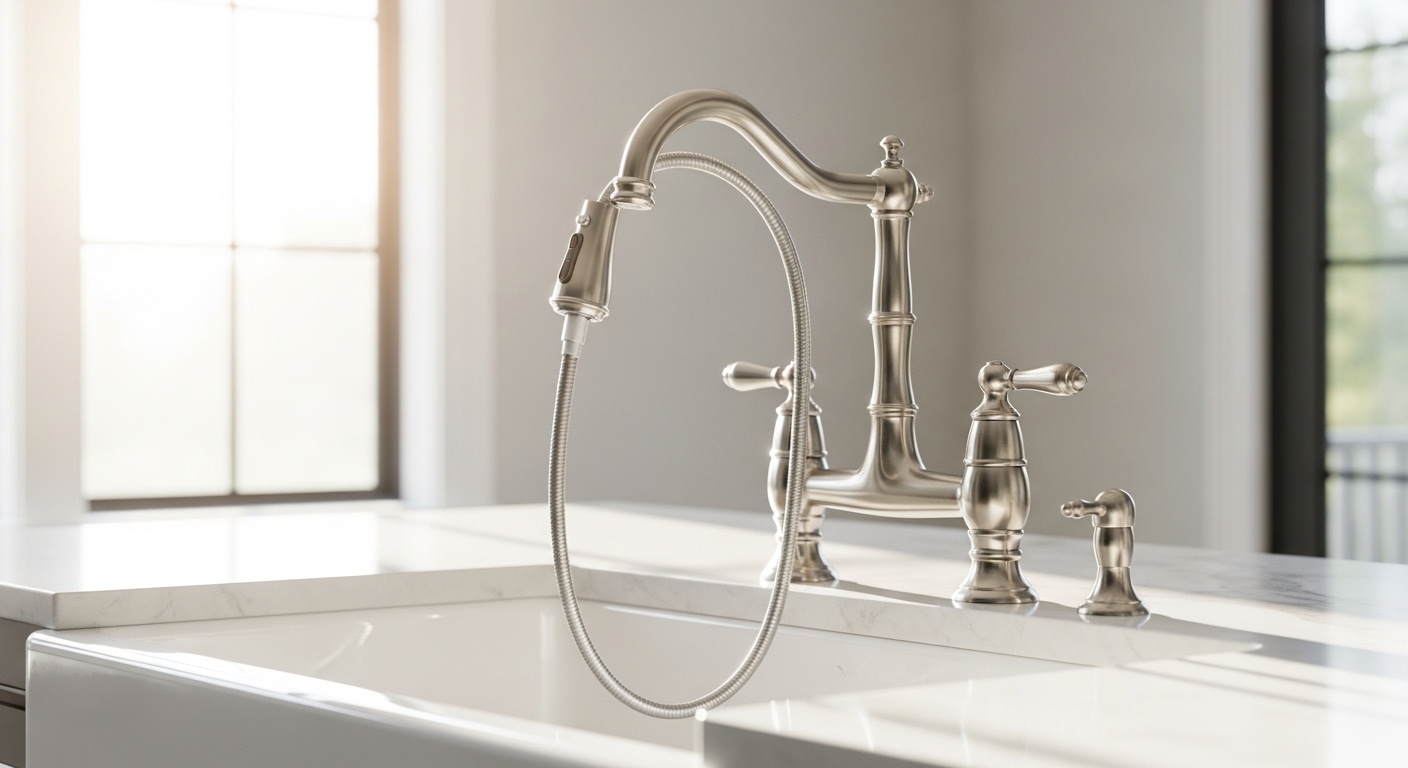
A pull down kitchen faucet with two handles is one of the most versatile fixtures you can install above a modern kitchen sink. It combines the traditional aesthetic of separate hot and cold levers — long associated with farmhouse, transitional and bridge-style kitchens — with the docking magnetic spray head that has become a standard on premium single-lever faucets. The result is a workstation-friendly fixture that gives you fine temperature control while still letting you rinse a stockpot, fill a vase, or spray down a colander without dragging the entire faucet body around.
At VIGA, we’ve spent more than two decades engineering OEM and ODM faucets for North American kitchens, and we’ve watched the two-handle pull-down category grow from a niche bridge-style request into a mainstream best-seller. In this guide we’ll walk through the mechanical anatomy, the configurations you’ll see on a showroom floor, the finishes that hold up over a decade of daily use, and the buying criteria that actually matter when you compare brands online.
What Exactly Is a Pull Down Kitchen Faucet With Two Handles?
A pull down kitchen faucet with two handles is a hybrid fixture: it uses two independent valve handles — one for hot water and one for cold — mounted either on a unified bridge body or as separate deck-mounted levers, and it pairs them with a high-arc gooseneck spout that houses a retractable spray head. You operate the temperature and volume with the handles, then pull the wand straight down into the sink basin to reach corners, fill pots that won’t fit under the spout, or switch between aerated stream and pressurized rinse.
Compared to a single-handle pull-down — where one joystick controls both flow and temperature — the two-handle version gives you repeatable, precise temperature memory. Set the cold handle to a comfortable half-turn for hand washing and you can return to it every time without overshooting. Many serious home cooks and professional chefs prefer this control because it eliminates the temperature drift that happens when a joystick gets bumped mid-task.
Bridge vs. Deck-Mounted Two-Handle Pull-Down Configurations
There are two dominant body styles in this category. A bridge faucet connects the two handles to the spout through an exposed horizontal pipe sitting above the deck, giving it a classic English or French country look. A deck-mounted two-handle pull-down hides the connecting plumbing under the countertop and presents three separate components — left handle, spout, right handle — usually requiring a three-hole or four-hole sink configuration. Both styles can host a pull-down spray; the choice is mostly aesthetic and depends on how many pre-drilled holes your sink already has.
Why Buyers Are Choosing a Pull Down Kitchen Faucet With Two Handles in 2026
The two-handle pull-down has surged in popularity for three concrete reasons: ergonomics, aesthetics, and serviceability. Two handles distribute wear across two valve cartridges instead of one, which typically doubles the service life before a drip appears. The bridge or three-hole layout pairs naturally with the apron-front sinks, butcher-block counters, and unlacquered brass hardware that dominate current kitchen design. And when something does fail, you can rebuild one handle without taking the entire faucet offline.
Performance Benefits Over Single-Handle Pull-Downs
- Precise temperature control: Independent ceramic disc cartridges let you dial in exact warmth without the temperature drift common on joystick models.
- Longer cartridge life: Each handle handles roughly half the daily cycles, so a quality two-handle unit can exceed 500,000 cycles before service.
- Easier repair: You can shut off one side, replace a single cartridge, and keep the other handle in service while you wait for parts.
- Better thermal stability: When someone flushes a toilet elsewhere in the house, hot-side pressure drop is isolated from the cold side.
- Workstation compatibility: The pull-down wand reaches over accessory boards, colanders, and ledges in modern workstation sinks.
Anatomy of a Quality Two-Handle Pull-Down Faucet
Understanding the internals will help you separate genuine premium products from look-alikes. A well-built pull down kitchen faucet with two handles uses lead-free brass for the body and waterway, ceramic disc cartridges rated for at least 500,000 cycles, a PEX or braided stainless steel hose for the pull-down wand, and a counterweight or magnetic dock that retracts the spray head cleanly into the spout.
Brass remains the gold standard for waterways because it resists corrosion, handles temperature extremes, and is naturally bacteriostatic. If you want a deeper dive into why brass continues to dominate plumbing components, our explainer on why crucial plumbing components are made of brass covers the metallurgy and longevity case in detail.
Spray Head & Hose Mechanics
The spray head should offer at least two modes — aerated stream for filling and pressurized spray for rinsing — and increasingly a third “sweep” or “boost” mode for cleaning the sink basin. Look for silicone nozzles that you can wipe clean of mineral buildup with a fingertip. The pull-down hose should be braided stainless steel over a PEX core, with a swivel ball joint where it meets the spout to prevent kinking. A magnetic dock outperforms a gravity counterweight because it pulls the wand straight into the spout every time, even after thousands of cycles when the weight system would have loosened.
Valve Cartridges & Flow Control
Both handles should use ceramic disc cartridges, not rubber compression washers. Ceramic discs are essentially two polished plates that shear past each other; they don’t compress and don’t wear in the way old rubber seats did. Quarter-turn cartridges are common on bridge styles, while standard handle-style cartridges with a full range of motion are more common on deck-mounted three-hole sets.
Finish Options: What Holds Up Over a Decade
Finish is where buyers either fall in love or feel buyer’s remorse two years in. The finish has to survive citrus, coffee, hard water, and the occasional scouring pad. Here’s how the most common options stack up for a pull down kitchen faucet with two handles.
| Finish | Process | Durability (Years) | Best Kitchen Style | Fingerprint Resistance |
|---|---|---|---|---|
| Polished Chrome | Electroplated | 10+ | Modern, transitional | Moderate |
| Brushed Nickel | PVD or electroplated | 15+ | Transitional, farmhouse | Excellent |
| Matte Black | PVD coating | 10–15 | Modern, industrial | Excellent |
| Champagne Bronze | PVD coating | 15+ | Transitional, traditional | Very Good |
| Polished Brass | PVD or lacquered | 10+ | Traditional, eclectic | Good |
| Stainless Steel | PVD coating | 15+ | Modern, commercial | Excellent |
PVD (Physical Vapor Deposition) finishes are bonded at the molecular level and are far more scratch and chemical resistant than older electroplated coatings. If you’re torn between two of the most popular options, our breakdown of brushed nickel versus chrome faucet finishes walks through real-world maintenance and how each finish ages under daily kitchen use.
Sink Compatibility: Holes, Spacing & Deck Plates
Before you fall in love with a specific model, count the pre-drilled holes in your sink or countertop. A two-handle pull-down typically needs three or four holes: one for each handle, one for the spout, and sometimes a fourth for a soap dispenser or side spray. Centerset configurations cluster handles on a 4-inch deck plate, while widespread setups space the handles 8 to 16 inches apart from the spout.
If you’re renovating and choosing both sink and faucet together, you have full flexibility — choose a workstation sink with three holes drilled at 8-inch widespread, which accommodates almost any premium two-handle pull-down. If you’re retrofitting, measure carefully. Our guide on centerset versus widespread faucets explains hole spacing in detail and can help you confirm what your existing sink will accept.
Workstation Sink Compatibility
Modern workstation sinks include integrated ledges that hold cutting boards, drying racks, and colanders. A pull-down spray head is essential here because the wand can reach across these accessories to rinse vegetables on the cutting board or fill a stockpot resting on the bottom grid. Two handles work well on workstation sinks because the handles sit at the back deck, well clear of the work zone in the basin.
Flow Rate, Water Efficiency & Certifications
U.S. federal law caps residential kitchen faucet flow at 2.2 GPM (gallons per minute), and California, Colorado, Washington and several other states cap it at 1.8 GPM. A quality two-handle pull-down should hit its rated flow with stable pressure between 20 and 80 psi. Look for WaterSense labeling if you want to maximize efficiency without sacrificing rinse performance — WaterSense kitchen faucets must deliver at least 1.5 GPM at 60 psi while maintaining usable performance.
Beyond flow rate, look for these certifications stamped on the spec sheet:
- NSF/ANSI 61 & 372: Verifies that all wetted parts are lead-free and safe for potable water contact.
- UPC (Uniform Plumbing Code): Required in many North American jurisdictions; covers material, structural and performance standards. Our overview of UPC certification for kitchen faucets explains exactly what this stamp guarantees.
- cUPC / IAPMO: Canadian and U.S. plumbing code certification — essentially mandatory for any faucet sold legally in North America.
- CALGreen / California AB 1953: Confirms compliance with the strictest lead-content rules in the country.
- ADA Compliance: Lever handles operable with a closed fist and without tight grasping; important for aging-in-place kitchens.
Comparing the Top Two-Handle Pull-Down Configurations
Not every “two-handle pull-down” looks the same. Below is a comparison of the four configurations you’ll encounter when shopping in 2026, along with the use case each fits best.
| Configuration | Holes Required | Typical Price Range (USD) | Best For | Common Style |
|---|---|---|---|---|
| Bridge with Pull-Down | 2–3 | $320–$900 | Farmhouse, traditional kitchens | Exposed horizontal pipe, classic look |
| Three-Hole Widespread Pull-Down | 3 | $240–$700 | Transitional kitchens with widespread sinks | Independent handles flanking spout |
| Deck Plate Two-Handle Pull-Down | 1–3 (with plate) | $180–$520 | Retrofits where hole count is uncertain | Modern transitional |
| Commercial-Style Two-Handle Pull-Down | 3 | $380–$1,100 | Heavy-use home cooks, semi-pro kitchens | Coiled spring spout, industrial look |
The commercial-style two-handle pull-down deserves a special note. These spring-spout faucets borrow directly from restaurant pre-rinse stations and have exploded in popularity for residential use. If you’re considering this look, our deep dive into why commercial faucets are chosen by home kitchens covers durability, flow performance and design fit.
Installation Considerations
Installing a pull down kitchen faucet with two handles is moderately more involved than installing a single-handle model, but a confident DIYer can finish the job in 60 to 90 minutes. The two main complications are aligning three independent components (left handle, spout, right handle) to the sink deck, and routing the pull-down hose with enough slack inside the cabinet for the wand to extend fully without binding.
Tools and Prep Checklist
- Basin wrench (essential for reaching behind the sink)
- Adjustable wrench and Phillips screwdriver
- Plumber’s tape (PTFE)
- Bucket and old towels
- Flashlight or headlamp for under-cabinet work
- New supply lines if existing lines are more than 5 years old
- Optional: silicone caulk for sealing the deck plate to the countertop
Step-by-Step Installation Overview
- Shut off both hot and cold supply valves under the sink and open the existing faucet to relieve pressure.
- Disconnect supply lines, remove mounting nuts, and lift out the old faucet.
- Clean the sink deck thoroughly, removing any old putty or silicone.
- Drop the new spout body through the center hole, then position each handle in its outer hole. Hand-tighten the mounting hardware from below.
- Align all three components so handles are parallel and the spout faces straight forward, then fully tighten the mounting nuts.
- Connect supply lines to each handle valve, using PTFE tape on threaded fittings.
- Route the pull-down hose through the spout, attach the weight (if counterweight model) and connect the hose to the cold/hot mixed outlet.
- Turn supplies back on slowly, check for leaks, then run water for 60 seconds with the aerator removed to flush debris.
- Reinstall the aerator, test the pull-down docking action, and verify both handles deliver smooth temperature transitions.
Common Problems and How to Avoid Them
Even premium two-handle pull-downs can develop issues over the years. Most are preventable with proper installation and basic maintenance. The most frequent complaints are wand retraction failure (usually a hose snag inside the cabinet), spray head mineral buildup, and handle stiffness from cartridge wear. For a broader troubleshooting framework that applies to most kitchen and bathroom fixtures, see our roundup of the top 5 faucet problems and solutions.
Wand Won’t Retract Smoothly
Open the cabinet and look for the hose catching on a garbage disposal, a stop valve, or the side of the basket strainer. Re-route the hose with a gentle loop and verify the counterweight (or magnet) can travel freely. On magnetic-dock models, mineral buildup on the steel ring inside the spout can weaken the magnetic grab — wipe the ring with a vinegar-soaked cloth.
Reduced Flow or Sputtering Spray
Unscrew the aerator and soak it in white vinegar for 30 minutes. Repeat with the spray head. Hard water deposits accumulate fastest on silicone nozzles, but a thumb rub usually clears them.
One Handle Drips After a Few Years
Replace the affected ceramic disc cartridge — most manufacturers sell them as a $15–$30 service kit. The opposite handle does not need attention, which is one of the structural advantages of the two-handle design.
VIGA Manufacturing Standards & Warranty
VIGA operates a vertically integrated factory in Kaiping, China — the historic center of North American faucet manufacturing — where we cast brass bodies, electroplate or PVD-coat finishes, and assemble each pull-down faucet under ISO 9001 quality controls. Every two-handle pull-down model is pressure tested to 200 psi (well above residential supply pressure), cycle tested to 500,000 actuations per handle, and salt-spray tested for finish corrosion resistance per ASTM B117. We back each unit with a limited lifetime warranty on the brass body and finish, and a 5-year warranty on the pull-down wand and hose assembly.
Whether you are sourcing a single unit for a remodel or specifying a private-label run for a kitchen showroom, our team supports both. Buyers interested in private-label or specification work can review our guide to OEM faucets or our overview of VIGA as a Kaiping-based OEM and ODM manufacturer.
How to Choose the Right Model for Your Kitchen
Use this decision framework when narrowing down a pull down kitchen faucet with two handles:
- Count your sink holes — this immediately rules out half the catalog.
- Pick your aesthetic — bridge for traditional, three-hole widespread for transitional, spring-spout commercial for industrial.
- Choose your finish based on lifestyle — matte black hides smudges in busy households; brushed nickel forgives water spots in hard-water regions.
- Verify flow rate and certifications — confirm UPC, NSF 61/372 and (where applicable) WaterSense or CALGreen.
- Confirm wand mechanics — magnetic docks outperform counterweights long-term.
- Read the warranty carefully — separate coverage for finish, body, and hose tells you where the manufacturer trusts its own product.
About the Author & VIGA
Author note: This guide was prepared by VIGA’s product engineering and marketing team, drawing on more than 20 years of faucet manufacturing experience and direct collaboration with North American kitchen designers, plumbing wholesalers, and licensed contractors. Our team includes mechanical engineers who specify ceramic cartridge tolerances, materials scientists who validate PVD finish coatings, and quality inspectors who pressure- and cycle-test every production batch.
About VIGA: Founded in Kaiping, Guangdong — China’s faucet capital — VIGA manufactures kitchen and bathroom faucets for distributors, e-commerce brands, and hospitality projects worldwide. Our products meet UPC, cUPC, NSF/ANSI 61 and 372, and CALGreen requirements, and our facility is certified to ISO 9001 and ISO 14001. We ship from a 40,000-square-meter factory with capacity for both small-batch boutique orders and full-container OEM runs.
FAQ
Is a pull down kitchen faucet with two handles harder to install than a single-handle?
Slightly. You’re aligning three components instead of one, and you need to connect supply lines to two independent valve cartridges before the mixed water reaches the pull-down hose. For a confident DIYer, plan on 60 to 90 minutes versus 30 to 45 for a single-handle install. The most important step is dry-fitting all three components before tightening anything down so the handles end up parallel and the spout faces straight.
Will a two-handle pull-down work on a 3-hole sink with 8-inch spread?
Yes — that is in fact the most common configuration. A standard 8-inch widespread three-hole sink is the native home for a deck-mounted two-handle pull-down. Confirm the spec sheet lists “8 inch widespread” or “3-hole 8-inch on center” and you’re good. Bridge faucets sometimes require additional clearance behind the sink; check the body depth.
Does a two-handle pull-down save water compared to a single-handle?
Indirectly, yes. Because you can dial in a precise warm temperature and return to it instantly, you waste less water waiting for the right temperature than with a joystick that you reset every time. Combined with a WaterSense-rated aerator at 1.5 GPM, a quality two-handle pull-down can reduce kitchen water use by 10 to 20 percent versus an older 2.2 GPM single-handle faucet.
What’s the difference between a bridge faucet and a three-hole widespread two-handle pull-down?
A bridge faucet connects the handles and spout via an exposed horizontal pipe sitting above the sink deck, which gives it a vintage, country look. A three-hole widespread has no visible bridge — the connecting plumbing is hidden below the countertop. Both can support a pull-down spray, and both typically need three sink holes. Choice is mostly aesthetic.
How long should the pull-down hose last?
A quality braided stainless steel hose with a PEX inner core should last 10 to 15 years of normal residential use. Most manufacturers offer hose replacements as a $20–$40 service part. If you start noticing reduced flow or a small leak inside the cabinet, replace the hose before it ruptures.
Can I use a two-handle pull-down with a water filter or instant-hot dispenser?
Yes. A two-handle pull-down doesn’t interfere with under-sink water filters, reverse osmosis systems, or instant-hot dispensers. If your sink has a fourth hole, you can mount the filtered-water dispenser or instant-hot tap right next to the faucet. The two-handle layout actually gives you a cleaner countertop because everything is in a row.
What finish is easiest to maintain in a hard-water region?
Brushed nickel and stainless steel PVD finishes hide water spots best. Polished chrome shows every droplet but wipes clean easily. Matte black hides fingerprints but can show mineral residue as a faint white haze — a quick wipe with a damp microfiber clears it.
Does VIGA offer custom finishes or branded versions of two-handle pull-down faucets?
Yes. We support OEM and ODM projects with custom PVD finishes, branded handles, packaging, and documentation. Minimum order quantities are flexible for emerging brands.
WeChat
Scan the QR Code with WeChat