 iVIGA Faucet Manufacturer & Factory

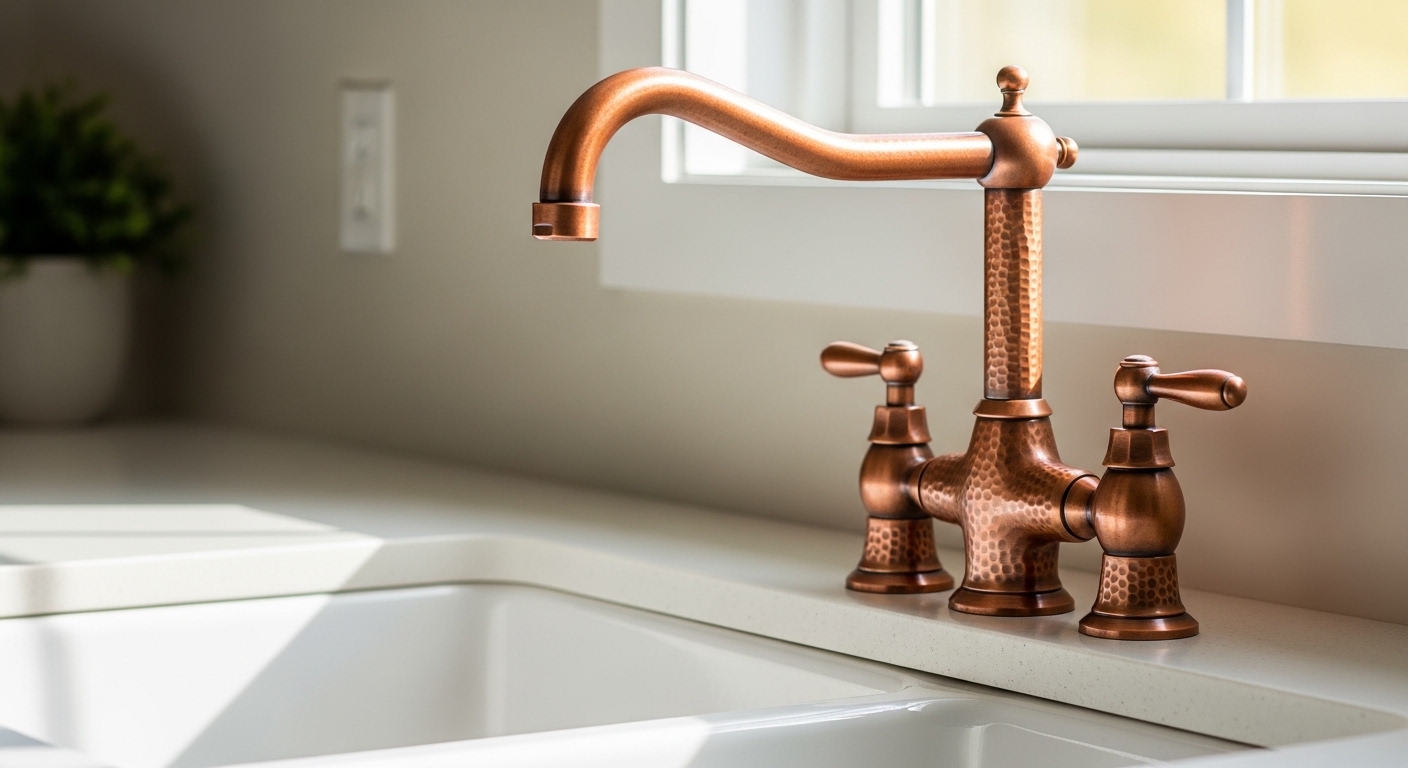
Search “copper faucet vintage” today and you’ll get everything from $40 painted lookalikes that flake in six months to $1,200 hand-hammered farmhouse pieces. The gap between those two extremes is where most buyers get burned. This guide cuts through it: what “vintage copper” actually means in 2026, how to spot the fakes, which finish (polished, antique, hammered, oil-rubbed) fits your kitchen or bath, and the specific specs — cartridge type, flow rate, mounting style, certifications — that decide whether the faucet still works beautifully a decade from now. Written for real homeowners and small renovators, not catalog copywriters.
What exactly makes a faucet “vintage copper” — and is it really copper?
A true vintage copper faucet is a faucet whose visible body is either solid copper or solid brass plated with a real copper layer, then finished to look aged — usually through hand-hammering, antiquing chemicals that deepen the patina, or an oil-rubbed wax seal. “Vintage” is the styling cue (exposed cross handles, Victorian curves, hammered texture, telephone-style sprayers); “copper” is the metallurgy.
Here’s the catch most shoppers miss: 90% of inexpensive “copper” faucets on Amazon and Wayfair are zinc-alloy bodies with a copper-colored PVD coating or, worse, a painted lacquer. They photograph beautifully and fail within 2–4 years. A genuine copper faucet vintage piece will use one of three constructions, and you should know which before you click buy:
- Solid copper body — rare, heavy (2–4 lbs for a kitchen unit), develops natural patina, $400+.
- Lead-free brass body with electroplated copper finish — the industry standard for quality vintage looks, durable, $180–$500.
- Zinc alloy with PVD copper coating — budget tier, lighter weight, finish lifespan typically 3–6 years, $60–$150.
If a listing won’t tell you the body material, assume it’s zinc. Reputable manufacturers like vigacc publish the spec sheet upfront because brass is the workhorse of plumbing for good reason — see why crucial plumbing components are made of brass for the metallurgy behind it.
Will a copper faucet turn green or look gross over time?
It will develop a patina — and whether that looks “gross” or “gorgeous” depends entirely on the finish you choose at purchase. Polished copper will darken and develop greenish verdigris spots within 6–18 months in humid bathrooms unless you wax it monthly. Antique, hammered, and oil-rubbed copper finishes are pre-aged and sealed; they evolve subtly but never turn the streaky-green color people fear.
The chemistry is simple: copper reacts with oxygen, water, and skin oils to form copper oxide (the warm brown patina) and, in chloride-rich environments, copper chloride (the bluish-green verdigris). Manufacturers control this with:
- Clear lacquer topcoats — freeze the color but can chip and yellow.
- PVD (Physical Vapor Deposition) sealing — molecular bond, 10+ year lifespan, the gold standard in 2026.
- Living finish — intentionally unsealed; meant to age, popular in farmhouse and craftsman aesthetics.
For a kitchen faucet that sees daily citrus and dish soap, choose PVD-sealed antique or hammered copper. For a powder room where you want the metal to “live,” a waxed living finish is fine. The choice between sealed and living is more important than the color itself.
Which vintage copper faucet style fits my space — kitchen, bath, or bar?
Match the spout shape and handle style to the sink type and the room’s existing fixtures. A high-arc gooseneck copper faucet looks stunning over a farmhouse apron sink but will splash in a shallow 5″ bar sink; a low-spread bridge faucet anchors a Victorian vanity but loses presence on a 36″ island. Here’s the practical mapping:
| Style | Best For | Typical Spout Height | Mounting | Price Range (USD) |
|---|---|---|---|---|
| Bridge faucet (twin handles, exposed bridge) | Farmhouse kitchens, butler’s pantries | 10″–14″ | 2-hole deck | $320–$650 |
| High-arc gooseneck with pull-down | Modern-vintage kitchens, deep sinks | 16″–19″ | 1 or 3 hole | $280–$580 |
| Widespread lavatory (3-piece) | Master baths, Victorian vanities | 5″–7″ | 3-hole, 8″ spread | $220–$480 |
| Centerset lav (4″ spread) | Powder rooms, smaller vanities | 4″–6″ | 3-hole, 4″ spread | $140–$260 |
| Wall-mount bridge | Vessel sinks, freestanding tubs | Varies | Wall, 8″ spread | $350–$720 |
| Bar / prep faucet | Bar sinks, secondary prep stations | 10″–12″ | 1-hole deck | $160–$320 |
If you’re torn between 4″ and 8″ spreads, the centerset vs widespread comparison walks through deck-space requirements and which one suits older sinks with non-standard hole spacing.
Kitchen pick: gooseneck or bridge?
Bridge faucets win on pure visual drama and are the most “vintage” of the vintage; goosenecks win on workability for filling stockpots and washing sheet pans. If you cook more than you photograph, get the gooseneck. A pull-down sprayer disguised inside a hammered copper spout gives you 2026 function with 1920s looks — the best of both eras.
Bathroom pick: widespread or centerset?
An 8″ widespread reads as luxurious and period-correct on any vanity wider than 30″. A 4″ centerset is right for powder rooms and guest baths under 30″, and it costs less because there’s less hardware. Match the handle style — cross handles for the most authentic Victorian feel, lever handles for a transitional vintage-industrial look.
How do I know if a vintage copper faucet is actually well-made (not a $79 trap)?
Check four specs before you check the price: body material, cartridge type, finish process, and certification. If any of those four are vague or missing from the listing, the faucet is almost certainly mass-market disposable hardware dressed in a vintage costume.
- Body weight. A kitchen copper faucet should weigh at least 4 lbs. A widespread lavatory set should weigh 3.5 lbs+. Light weight = zinc alloy = short lifespan.
- Cartridge. Demand ceramic disc cartridges rated for 500,000+ cycles. Rubber compression cartridges are 1950s tech and drip within two years.
- Finish. “PVD copper” or “hand-antiqued and sealed” is good. “Copper-plated” with no further detail is a yellow flag. “Copper-colored” is a red flag.
- Certifications. Look for cUPC, NSF/ANSI 61 (lead-free, drinking-water safe), NSF/ANSI 372 (lead content ≤0.25%), and CALGreen / WaterSense for flow rate.
Certification isn’t paperwork theater — it’s the difference between a faucet that meets federal Safe Drinking Water Act limits and one that might leach lead. The UPC certification explainer breaks down exactly what each mark actually tests for.
What does a vintage copper faucet really cost in 2026 — and where are the hidden fees?
Budget $180–$280 for an entry-level quality piece, $280–$450 for the sweet spot, and $450–$900 for premium hand-hammered or designer pieces. Below $150 you’re buying a costume; above $1,000 you’re paying for the brand name unless the faucet is genuinely artisan-made.
The hidden costs nobody mentions in the product photo:
- Pop-up drain assembly — $40–$90 if not included; matching copper finish is critical.
- Supply lines — braided stainless is $15–$25/pair; copper-jacketed for show pieces runs $50+.
- Escutcheon plate — needed if you’re converting a 3-hole sink to a single-hole faucet, $30–$70.
- Sink hole reaming — if your existing sink’s holes are too small for the new faucet’s shank, expect $80–$150 from a plumber, or a damaged sink if you DIY.
- Cartridge replacements — every 8–10 years on quality models, $20–$45 each.
Factor those in before comparing the sticker prices. A “$199 deal” that needs a $90 drain, $25 supplies, and a $60 escutcheon is suddenly a $374 install.
How do I install and care for a copper faucet so it lasts 15+ years?
Most failures aren’t the faucet — they’re the install and the cleaning routine. Use the right cartridge orientation, the right wrench (basin wrench, not adjustable pliers on a soft copper body), and stop using citrus-based countertop cleaners on the spout.
Installation checklist
- Shut off both supply valves under the sink and open the old faucet to bleed pressure.
- Disconnect supply lines from the angle stops, not from the faucet, to avoid stripping the brass nuts.
- Remove the old faucet from above with a basin wrench. Clean the deck.
- Dry-fit the new copper faucet — confirm hole spacing, spout reach, and handle clearance to the backsplash.
- Apply plumber’s putty (not silicone) under the base if the manufacturer specifies it; many copper bases use a rubber gasket instead.
- Hand-tighten mounting nuts from below, then quarter-turn with a wrench. Over-tightening cracks ceramic cartridges.
- Connect braided supply lines, turn water on slowly, and check for drips before walking away.
Care routine that actually preserves the finish
- Daily: wipe dry with a soft cotton cloth after use. Water minerals are the #1 enemy.
- Weekly: mild dish soap and warm water. Never vinegar, never lemon, never abrasive sponges.
- Quarterly: apply a thin coat of carnauba wax to living-finish copper to slow oxidation.
- Annually: unscrew the aerator, soak in warm soapy water (skip the vinegar — it strips copper), brush, reinstall.
If you’re on hard water, install an aerator with a built-in flow restrictor and consider a whole-home softener. Mineral scale eats finishes faster than any other single factor — the top 5 faucet problems guide covers diagnostics for hard-water buildup, pressure issues, and leaks.
Polished, antique, hammered, or oil-rubbed copper — which finish is right for me?
Pick by lifestyle, not by Pinterest board. Polished copper is the highest-maintenance finish (frequent waxing) and the most dramatic; antique copper is the most forgiving and ages gracefully; hammered copper hides water spots and fingerprints better than any other finish; oil-rubbed copper reads almost black with copper highlights and pairs with darker palettes.
| Finish | Look | Maintenance | Best Room | Hides Water Spots? |
|---|---|---|---|---|
| Polished Copper | Bright orange-pink mirror | High — wax monthly | Low-use powder room | No |
| Antique Copper | Warm brown with darker recesses | Low | Kitchen, master bath | Mostly |
| Hammered Copper | Textured, variegated | Very low | Farmhouse kitchen, bar | Yes |
| Oil-Rubbed Copper | Near-black with copper undertones | Low | Traditional bath, craftsman | Yes |
| Living Copper (unsealed) | Evolves continuously | Owner-dependent | Statement pieces | Varies |
If you’re cross-shopping warm-metal finishes more broadly, the oil-rubbed bronze kitchen faucet roundup is a useful sister-read — bronze and copper occupy similar design territory but behave differently under hard water and cleaning chemicals.
Will a vintage copper faucet match my existing fixtures and appliances?
Mostly yes, with two rules: never mix more than three metal tones in one room, and treat copper as the dominant warm tone, not a supporting accent. Copper plays beautifully with brushed brass, matte black, and unlacquered nickel; it fights with chrome, polished nickel, and stainless steel appliances unless you deliberately go for an eclectic mix.
Stainless steel appliances are the most common worry. The trick: separate them visually with a wood or stone surface, and add at least one other copper element (pendant light, drawer pulls, soap dispenser) so the faucet doesn’t read as a lonely outlier. Two copper touchpoints make it a design choice; one makes it a mismatch.
Why VIGA — and what should you expect from a serious copper faucet manufacturer?
VIGA (vigacc) has manufactured faucets in Kaiping, China — the global capital of faucet production — since 1999. Every copper faucet vintage piece in our catalog uses lead-free brass bodies (≤0.25% lead per NSF/ANSI 372), ceramic disc cartridges rated to 500,000 cycles, PVD-sealed finishes, and ships with a 5-year finish warranty plus a lifetime functional warranty on the cartridge. We hold cUPC, CE, WaterMark, and NSF 61 certifications, and our small-batch program means you can order as few as 50 units for boutique projects — see the flexible production overview for details.
For homeowners, that means the faucet you receive matches the spec sheet, the finish doesn’t lift, and the cartridge is field-replaceable a decade from now. For designers, builders, and small e-commerce brands, it means consistent inventory and OEM/ODM options without minimum-order anxiety.
FAQ
Is a copper faucet sanitary in a kitchen?
Yes — more so than most metals. Copper is naturally antimicrobial; studies cited by the EPA show copper surfaces kill 99.9% of common bacteria (including E. coli and MRSA) within two hours of contact. That property is preserved in PVD-sealed and living-finish copper faucets. Lacquered finishes lose the effect because the surface bacteria touch is the lacquer, not the metal.
Do copper faucets cost more to run because of water flow restrictions?
No — flow rate is determined by the aerator, not the metal. Most quality copper kitchen faucets ship with a 1.5–1.8 GPM aerator (WaterSense certified at ≤1.8 GPM) and lavatory faucets with 1.2 GPM. You can swap aerators in 30 seconds to dial flow up or down within the legal limit for your state. California, Colorado, Washington, and several other states cap kitchen faucets at 1.8 GPM by law.
Can I install a vintage copper faucet myself?
If you’re replacing a faucet in the same hole configuration, yes — most installs take 45–90 minutes with a basin wrench, an adjustable wrench, and braided supply lines. If you’re going from a single-hole to a widespread (or vice versa), or changing sink hole sizes, hire a plumber. Cracking a porcelain sink while reaming a hole costs more than the faucet.
What’s the difference between vintage copper and antique brass?
Copper is the elemental metal Cu; brass is an alloy of copper and zinc. Antique brass finishes are typically warmer and more yellow-gold; copper finishes lean orange-pink. Vintage copper faucets are usually brass-bodied with a copper finish, so internally they’re often identical to antique brass faucets — the difference is the visible top layer.
Will hard water ruin my copper finish?
It can damage polished and living finishes within 1–2 years if not wiped dry. Antique, hammered, and oil-rubbed PVD-sealed copper faucets handle hard water far better because the texture and dark tones disguise mineral spots, and the PVD layer resists etching. If your water hardness is above 7 grains per gallon, prioritize a textured or dark finish — and dry the spout daily.
Do vintage copper faucets come in pull-down or pull-out sprayer versions?
Yes, and they’re increasingly common in 2026. Look for faucets where the sprayer head is copper-finished to match the spout (not chrome with a copper collar — a common cost-cut). Magnetic dock systems are now standard on quality models and prevent the sprayer head from drooping over time.
How long does a quality copper faucet actually last?
Body: indefinitely if it’s solid brass with a real copper finish. Cartridge: 8–15 years before needing a $30 replacement. Aerator: 2–5 years before mineral clogging, easily swapped. A $350 vintage copper faucet installed today should still be working in 2041, while the same money spent on three sequential $120 zinc-bodied faucets will end up costing more and leaking sooner.
Author note: This guide is written by the VIGA editorial team in collaboration with our in-house product engineers — the same team that specs and tests every faucet leaving our Kaiping factory. We’ve sold to over 80 countries since 1999 and stand behind every product with a 5-year finish warranty and lifetime cartridge guarantee. Last updated June 2026.
WeChat
Scan the QR Code with WeChat