 iVIGA Faucet Manufacturer & Factory

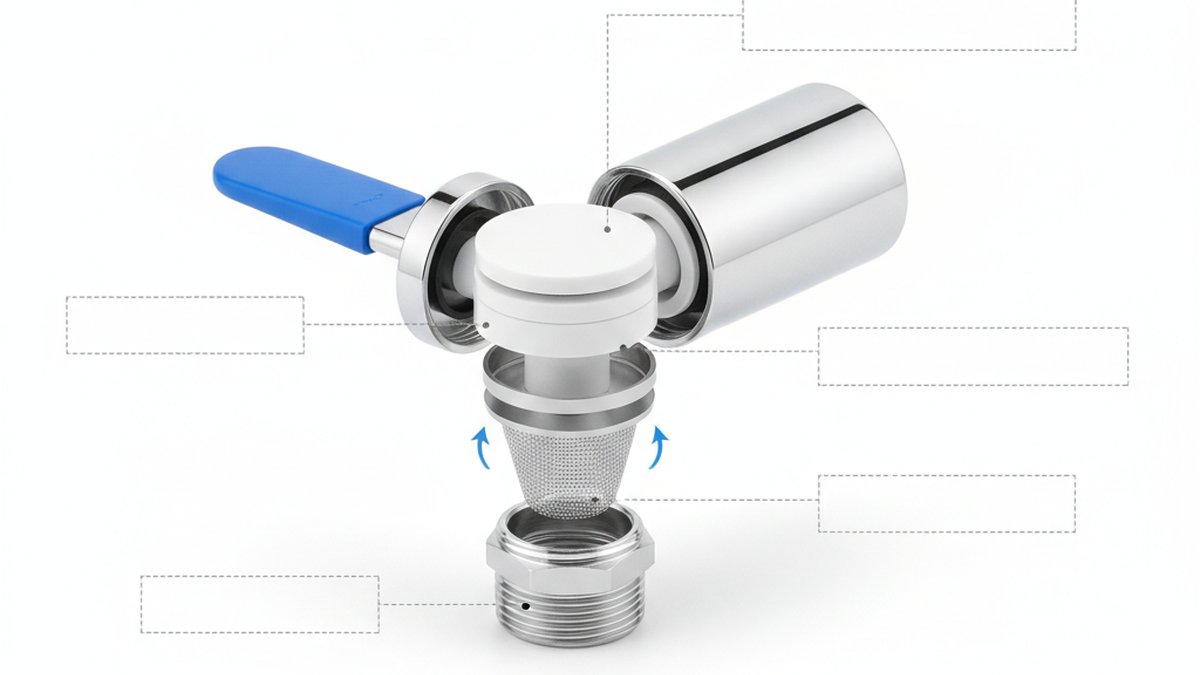
A tap aerator one touch is the easiest upgrade you can make to a faucet you already own. It replaces the standard aerator that screws onto the end of your spout, but adds a little flip-lever or push button that stops the flow instantly — one touch off, one touch on — while keeping your temperature and pressure exactly where you last set them. You do not touch the main handle, you do not re-mix hot and cold, and you do not waste the seconds (and liters) it normally takes to get the water right again. Below, iVIGA’s product team walks through what it actually is, whether it’s worth the money, how to pick the right thread and flow rate, and how to install one in about two minutes.
What exactly is a “one touch” tap aerator, and how is it different from a normal one?
A one touch aerator is a standard faucet aerator with an added on/off toggle — a small lever, paddle, or button on the side that shuts the water off at the tip without moving the faucet handle. A normal aerator only mixes air into the stream to soften it and reduce splashing; a one touch model does that and gives you an instant pause.
Here’s why that pause matters in real life. When you’re washing your hands, lathering dishes, brushing teeth, or shaving, you don’t need water running the whole time — but reaching over to shut off a wet, soapy single-lever handle is annoying, and when you turn it back on you’ve lost your temperature setting. The one touch lever lets you kill the flow with the back of your wrist or a knuckle, then bring it right back at the same warmth. The stream had been running for years; the toggle just gives you control over the last few centimeters.
Mechanically, most one touch aerators use a small ceramic or rubber disc valve behind the mesh screen. When you flip the lever, the disc seats and stops the water; flip it back and it reopens. Because the shut-off happens at the tip and not at the cartridge, your faucet’s main valve stays open and your mix is preserved.
Is a tap aerator one touch actually worth it, or is it a gimmick?
For most homes, yes — it’s worth it, and it’s one of the cheapest water-saving upgrades that actually changes behavior. A quality one touch aerator costs about the same as a coffee, installs in two minutes with no tools, and cuts the amount of water and heated water you waste during “in-between” moments (soaping, scrubbing, rinsing a single dish).
The math is simple. A conventional aerator flows around 8.3 liters per minute (2.2 GPM) if it’s older, while modern water-saving aerators are 5.7 LPM (1.5 GPM), 3.8 LPM (1.0 GPM), or lower. When you add one touch control, the real saving isn’t just the flow rate — it’s the run time. If four people each avoid 30–60 seconds of pointless running per day, you’re realistically saving hundreds of liters a month, plus the energy to heat the hot portion of it. That’s where the “up to 30–50%” figure comes from: it’s the combined effect of a lower flow rate and less run time.
Where it’s not worth it: if you already have a genuine touchless or touch-activated faucet, a manual one touch aerator is redundant. And if your faucet has a hidden/internal aerator with a non-standard housing (common on some high-end pull-down kitchen faucets), a universal one touch tip may not fit — you’d want a matched insert instead.
One touch aerator vs. standard aerator vs. touchless faucet — which should you pick?
Pick a one touch aerator if you want water savings and instant on/off without buying a whole new faucet. Pick a standard aerator if you only care about splash control and cost. Go touchless only if you’re already replacing the faucet and want a hands-free experience. Here’s the honest comparison:
| Feature | Standard Aerator | One Touch Aerator | Touchless Faucet |
|---|---|---|---|
| Typical cost | $3–$8 | $8–$20 | $150–$500+ |
| Instant on/off at the tip | No | Yes | Yes (sensor) |
| Keeps your temperature setting | N/A | Yes | Yes |
| Installation | Screw on, 2 min | Screw on, 2 min | Full faucet swap |
| Needs power/batteries | No | No | Yes |
| Water savings potential | Low–medium | Medium–high | High |
| Splash reduction | Yes | Yes | Yes |
The sweet spot for renters, budget-conscious homeowners, and anyone who hates the idea of rewiring or replacing a working faucet is clearly the one touch aerator. You get the two best parts of a touchless faucet — instant control and preserved temperature — for a fraction of the price and with zero electronics to fail. If you’re also weighing a bigger upgrade, our guide to the best kitchen faucet for durable everyday use covers when a full replacement makes more sense.
What size and thread do I need — how do I know a one touch aerator will fit my tap?
Measure the thread and check the direction: most bathroom and kitchen faucets use one of a handful of standard sizes, and the aerator is either male (threads on the outside) or female (threads inside the housing). Match both the diameter and the male/female type and you’re done.
The most common sizes you’ll run into:
- Regular male: 15/16″ (about 24 mm) — the most common US kitchen/bath thread.
- Regular female: 55/64″ (about 22 mm) — very common on bathroom faucets.
- Junior/small male: 13/16″ (about 21 mm).
- Tom Thumb/small female: 3/4″ (about 18.5 mm).
- Metric (common outside the US): M22 male and M24 female.
The easiest way to check: unscrew your current aerator by hand (turn it toward you as you face the spout — lefty-loosey). If the threads are on the outside of the piece you removed, you need a male aerator; if the threads are inside, you need female. Many one touch kits ship with a small rubber washer and both a male and female adapter so they fit the majority of taps out of the box. If yours is stuck with mineral buildup, a rubber jar-opener grip or a cloth-wrapped wrench does the trick — and the same limescale that seizes an aerator is often behind weak flow, which we cover in why your kitchen faucet has low water pressure and how to restore it.
How do I install a one touch tap aerator myself?
You install it by unscrewing the old aerator and screwing the new one on hand-tight — no plumber, no tools required in most cases. The whole job takes about two minutes. Here’s the reliable sequence:
- Turn the faucet fully off. Lay a cloth over the drain so nothing small gets lost.
- Unscrew the existing aerator counter-clockwise (as you look up at the spout). Hand pressure usually works; use a rubber grip if it’s tight.
- Clean the spout threads. Wipe away old grit and rinse loose limescale so the new part seats flush.
- Check the rubber washer is seated inside the new one touch aerator (and fit the male/female adapter if your kit includes one).
- Screw the new aerator on clockwise, hand-tight only. Over-tightening cracks the plastic housing or crushes the washer.
- Run the water and test the lever — flip it off, flip it on. Look at the threads for drips. If it weeps, snug it a quarter-turn more or reseat the washer.
If you notice a persistent drip from the threads after this, it’s almost always the washer — not a faulty faucet. If the drip is coming from the base of the spout or the handle instead, that’s a different repair; our walkthrough on how to fix a kitchen faucet drip yourself shows how to tell them apart.
Does a one touch aerator reduce water pressure, and will the flow feel weak?
A well-made one touch aerator does not noticeably reduce your pressure — it controls flow rate, which is a different thing. Pressure is how hard the water is pushed (measured in PSI/bar and set by your home’s supply); flow rate is how much comes out per minute (GPM/LPM, set by the aerator). A 1.5 GPM aerator will feel full and forceful because the aeration mixes air in to give the stream body, even though less water is actually flowing.
Where people get a genuinely weak stream is one of three things: the aerator screen is clogged with sediment (rinse or soak it in vinegar), the flow rate is simply too low for the task (a 1.0 GPM tip on a kitchen faucet you use to fill pots will feel slow — go 1.5 or 1.8 GPM there), or the home’s pressure was already marginal. Choose the flow rate to match the sink: 1.0–1.2 GPM is great for a bathroom hand-washing basin, while 1.5–1.8 GPM keeps a kitchen faucet practical for filling pots and rinsing produce.
Which iVIGA one touch aerator is right for my kitchen or bathroom?
Match the flow rate and finish to the room. For a busy kitchen, choose a 1.5–1.8 GPM one touch aerator so pot-filling stays quick; for a bathroom basin, a 1.0–1.2 GPM model maximizes savings on tasks where you don’t need volume. iVIGA one touch aerators are machined with solid brass thread collars (not plastic) so they seat cleanly and survive repeated toggling, and they ship with both male and female adapters plus spare washers to fit the common thread sizes above.
Finish matters more than people expect: a mismatched aerator tip stands out on a nice faucet. iVIGA offers matched finishes — chrome, brushed nickel, and matte black — so the tip disappears into the spout. If you’re coordinating a whole look rather than just the tip, our overview of the best kitchen tap design for your sink pairs finishes and spout styles that work with these aerators.
How do you keep a one touch aerator working and clean?
Descale it every 2–3 months if you have hard water. The mesh screen and the small shut-off disc are the two parts that collect mineral scale, and scale is what makes the lever stiff or the stream spit. Maintenance is easy:
- Unscrew the aerator and rinse the screen under a strong tap in the reverse direction to flush grit out.
- Soak the whole tip in a 50/50 white vinegar and water solution for 30–60 minutes to dissolve limescale.
- Work the one touch lever a few times while it soaks so vinegar reaches the valve disc.
- Rinse, reseat the washer, and hand-tighten back on.
A one touch aerator does have one more moving part than a plain aerator, so buy quality: cheap units with a thin plastic lever and a rubber flap valve wear out or leak within a year, while a ceramic-disc valve in a brass body lasts for years of daily toggling.
FAQ
Does a one touch aerator waste water when it’s “off”?
No. When the lever is in the off position, the valve disc seats and stops the flow completely — there’s no bypass or trickle in a well-made unit. If yours drips while toggled off, the valve seat has scale on it or is worn; descale it, and replace it if the drip continues.
Can I use a one touch aerator with a pull-down or pull-out spray kitchen faucet?
Usually not directly. Pull-down and pull-out sprayers have their own integrated spray head and internal aerator, often with a proprietary housing, so a universal screw-on one touch tip typically won’t fit. On those faucets you’d use the manufacturer’s matched insert or add a one touch control at a separate fixed tap. Standard fixed-spout kitchen and bathroom faucets are the ideal candidates.
Will a one touch aerator work with a tankless or instant water heater?
Yes, but check the minimum flow rate your heater needs to fire. Some tankless heaters need a certain GPM to activate, and a very low-flow aerator (1.0 GPM) could sit below that threshold, causing the hot water to cut out. If you have a tankless system, choose a 1.5 GPM or higher one touch aerator to stay safely above the activation flow.
Is the water still aerated when I lower the flow?
Yes. The aeration screen mixes air into the stream regardless of the on/off lever, so the water stays soft, splash-free, and feels full even at lower flow rates. The one touch mechanism only starts and stops the flow — it doesn’t remove the aeration.
How long does a one touch aerator last?
A quality unit with a brass body and ceramic disc valve lasts several years of daily use; the mesh screen may need descaling every couple of months in hard-water areas but that’s routine cleaning, not failure. Cheaper all-plastic units with rubber flap valves often start dripping or sticking within 6–12 months, which is why the valve material is worth checking before you buy.
A note from the iVIGA product team
This guide was written by iVIGA’s faucet product team, drawing on our work designing and manufacturing kitchen and bathroom fixtures for markets worldwide. We test aerators and flow-control components for thread fit, flow-rate accuracy, and valve durability, and our fixtures are built to recognized plumbing standards (including cUPC and NSF/ANSI 61 for wetted materials) with manufacturer warranty support. Our recommendation to choose a brass-body, ceramic-disc one touch aerator over a cheap plastic one isn’t a sales line — it’s the difference we see between a part that lasts years and one that leaks in a season. If you’re unsure about thread size or flow rate for your specific sink, reach out through www.viga.cc and we’ll help you match the right part.
WeChat
Scan the QR Code with WeChat