 iVIGA Faucet Manufacturer & Factory

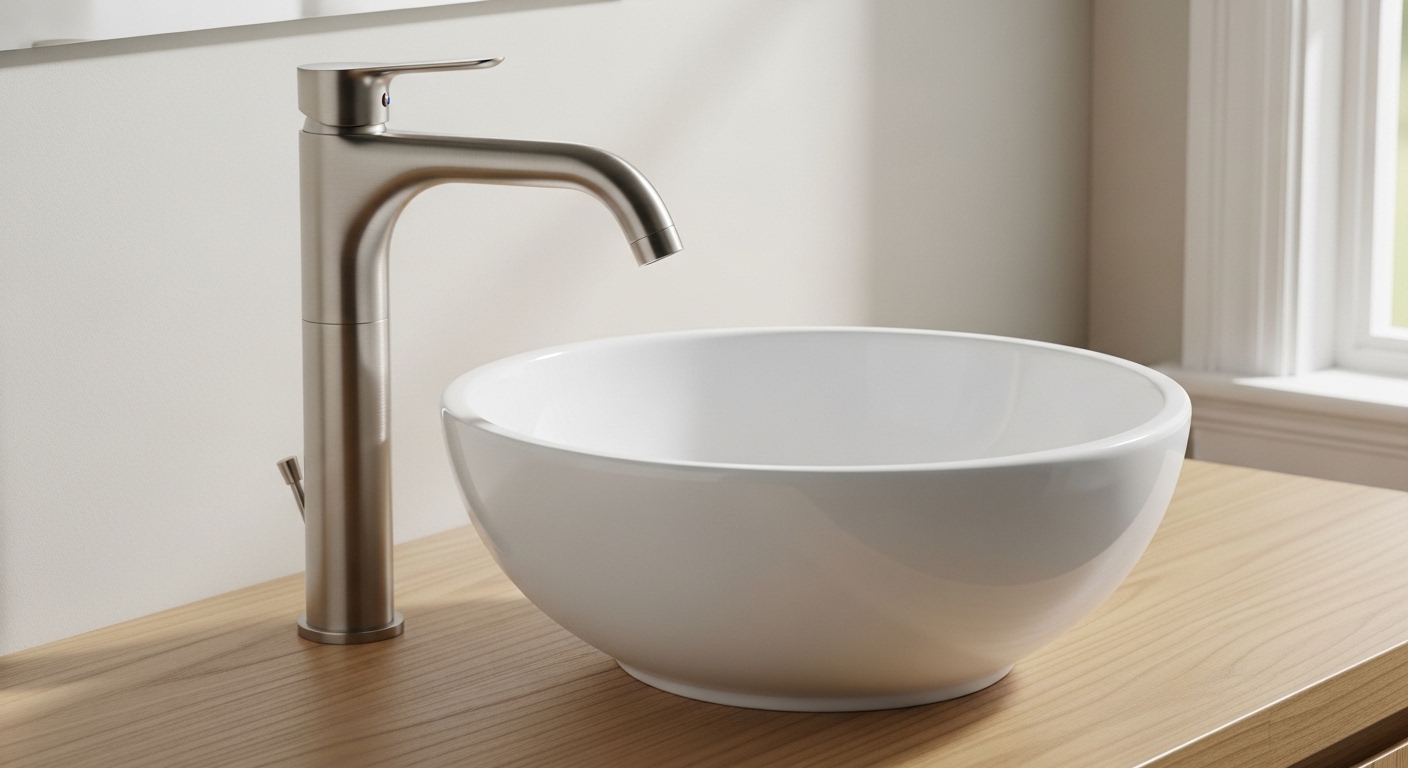
If you’ve been searching for a kraus ramus vessel sink faucet, you almost certainly already have — or are about to buy — a vessel sink: that bowl that sits on top of the counter instead of dropping into it. That single detail changes everything about the faucet you need, and it’s the number-one reason people end up returning the wrong faucet. Below, I’ll answer the real questions shoppers ask about the Ramus specifically, show you exactly how to measure so it fits, compare it against the alternatives, and tell you honestly when to buy it and when to look elsewhere.
What exactly is a “vessel” faucet, and why can’t I just use a normal bathroom faucet?
A vessel faucet is a tall faucet designed to clear the raised rim of an above-counter bowl — and no, a standard bathroom faucet usually won’t work. Regular lavatory faucets are built for sinks that sit flush with or below the countertop, so their spouts are only about 4 to 6 inches tall. A vessel bowl adds 4 to 6 inches of height on top of your counter, so a normal faucet ends up spitting water into the side of the bowl (or worse, behind it) instead of down into the drain.
The Kraus Ramus solves this with a spout that stands roughly 11 to 12 inches tall, with the water outlet positioned to pour down into the center of the bowl. That’s the entire point of a “vessel” faucet — height and reach matched to a bowl that sits proud of the counter. If you’re still deciding on the bowl-and-faucet pairing itself, our guide to the best vessel sink faucet with a deck plate for a single-hole vanity walks through fit and mounting in more detail.
Will the Kraus Ramus actually fit my vanity? (How to measure before you buy)
It fits any vanity with a single pre-drilled faucet hole between 1-1/4 and 1-3/8 inches (the standard US size), as long as your bowl height plus spout reach lands the water over the drain. That’s the short answer — here’s how to confirm it in five minutes with a tape measure.
- Measure your bowl height. Most vessel bowls are 4 to 6 inches tall. The faucet outlet needs to sit above that rim, and the Ramus’s ~11–12 inch spout clears bowls up to about 6 inches comfortably.
- Check the drilling. The Ramus is a single-hole, deck-mount faucet. If your counter already has a 3-hole (widespread) layout, you’ll need a base plate or a different faucet.
- Measure spout reach vs. bowl center. Sit the faucet where it will mount and confirm the outlet lands over the drain — not over the rim. A common mistake is a big bowl set too far forward, so the water hits the front lip.
- Confirm counter thickness. The mounting hardware handles typical stone and wood counters (up to about 1-3/4 inches). Very thick slabs can need longer bolts.
The single biggest returns driver on vessel faucets isn’t quality — it’s people not measuring bowl height against spout height. Do this one check and you’ll avoid 90% of the headaches.
Is the Kraus Ramus worth the money, or am I overpaying for a name?
For a mid-priced faucet in the roughly $130–$200 range, the Ramus gives you genuine value — a solid brass or stainless body, a drip-resistant ceramic cartridge, and a lifetime finish warranty — not just brand markup. Where you’d be “overpaying” is only if you buy a premium finish you don’t need, or if you assume a big brand name automatically means it’s the only good option. It isn’t. Plenty of comparable vessel faucets deliver the same core engineering.
What you’re actually paying for at this price is the cartridge and the finish, and both matter more than the logo:
- Ceramic disc cartridge: This is the part that turns the water on and off. Ceramic discs seal metal-to-metal with polished ceramic plates and are what keeps a faucet from dripping years down the line. If you want the full breakdown of why this matters, see our comparison of ceramic disc vs. ball valve faucets.
- Finish quality: A PVD or well-applied brushed finish resists corrosion and water spotting far better than a cheap electroplated one.
- Flow rate: Most models are limited to 1.2 GPM to meet WaterSense-style efficiency, which is plenty for a bathroom and saves water.
Which finish should I get — brushed nickel, matte black, or brushed gold?
Pick the finish that matches the metal you already have in the room: brushed nickel for a warm, forgiving everyday look, matte black for high-contrast modern vanities, and brushed gold for a soft, upscale statement. All three are low-maintenance; the practical differences come down to how they hide water spots and fingerprints.
| Finish | Best for | Hides water spots? | Maintenance |
|---|---|---|---|
| Brushed / Satin Nickel | Warm, traditional-to-transitional baths; hard-water homes | Excellent — the matte texture masks spotting | Very low; wipe with a damp cloth |
| Matte Black | Modern, high-contrast vanities with white or wood tones | Good, but dried limescale shows as white streaks | Low; needs occasional descaling in hard water |
| Brushed Gold / Brass | Warm, upscale, “boutique hotel” look | Excellent — very forgiving | Very low; avoid abrasive cleaners |
| Chrome (polished) | Budget-friendly, bright, classic | Poor — every spot shows | Higher; wipe dry to avoid spotting |
If you’re leaning warm and modern, our deep dive on the best brushed gold bathroom faucet finish for a modern vanity covers exactly how gold pairs with different bowl colors. Prefer a brighter, mirror-like metal instead? Weigh the trade-offs in polished nickel faucets pros and cons before you commit — polished finishes look stunning but show spotting faster.
Does a tall vessel faucet like the Ramus splash more?
It can, but only if the setup is wrong — the height itself isn’t the problem, the water landing spot is. Splashing happens when the stream hits a shallow bowl at a steep angle, or when high water pressure drives a hard jet. A properly matched faucet-and-bowl pairing barely splashes at all. Here’s how to keep it under control:
- Match spout height to bowl depth. A deeper bowl (5–6 inches) catches and absorbs the stream. Very shallow “plate” bowls splash more with any tall faucet.
- Aim for the center. Water hitting the drain area straight down splashes far less than water hitting the sloped side.
- Use the aerator. The Ramus’s aerator softens the stream into a gentler column and cuts splashing while saving water.
- Mind your pressure. If your home runs above 60 psi, the stream is more forceful everywhere; a pressure-reducing valve helps the whole house.
Bonus: that same aerator is the first thing to clean if flow ever drops. Even homes on softened water get buildup — here’s why your faucet aerator still clogs even when your water is soft.
How do I install the Kraus Ramus myself?
You can install it in about 30–45 minutes with basic tools and no plumber — it’s a single-hole deck mount, which is the easiest type to fit. Here’s the sequence:
- Shut off the water at the two supply valves under the vanity and open the old faucet to drain the lines.
- Remove the old faucet by loosening the mounting nut underneath and lifting it out. (If it’s seized, penetrating oil helps.)
- Drop the Ramus through the single hole, seating its base gasket flat against the counter so no water seeps underneath.
- Tighten the mounting nut from below, keeping the spout aimed over the drain.
- Connect the supply lines — hand-tight plus a quarter turn with a wrench. Don’t overtighten and crack the fitting.
- Install the pop-up drain if your bowl uses one, sealing with plumber’s putty or silicone.
- Turn the water back on slowly and check every connection for drips. Run it a full minute.
If you’re brand-new to this, the same fundamentals apply across brands — our step-by-step on how to properly install a faucet without calling a plumber covers the supply-line and shut-off steps in more depth.
How do I keep it looking new in a hard-water home?
Wipe it dry after heavy use and descale it monthly with a mild vinegar solution — that’s 95% of the maintenance. Hard water’s white, crusty limescale is the main enemy of any faucet finish, and it builds up fastest on the aerator and around the base. Never use abrasive pads or acidic bathroom cleaners on brushed or matte finishes; they dull and scratch the coating. For stubborn mineral crust, a targeted product works better than scrubbing — see our roundup of the best hard water cleaners for a faucet with stubborn lime buildup.
Kraus Ramus vs. a vigacc vessel faucet: which should you actually buy?
Buy the Kraus Ramus if you want a proven name-brand faucet in a specific finish and you’ve confirmed it fits your bowl. Consider a vigacc vessel faucet if you want the same tall-spout engineering — solid brass body, ceramic cartridge, WaterSense-friendly flow — with more finish and price flexibility. Both are single-hole, deck-mounted, drip-resistant faucets in the same class; the decision usually comes down to finish availability and budget.
| Feature | Kraus Ramus | vigacc Vessel Faucet |
|---|---|---|
| Mount type | Single-hole deck mount | Single-hole deck mount |
| Spout height | ~11–12 in. | ~11–13 in. (multiple models) |
| Cartridge | Ceramic disc | Ceramic disc |
| Body material | Brass / stainless | Solid brass |
| Flow rate | ~1.2 GPM | 1.2–1.5 GPM options |
| Finish choices | Nickel, black, gold (model-dependent) | Nickel, black, gold, chrome, bronze |
| Warranty | Limited lifetime | Limited lifetime finish & function |
The honest takeaway: there’s no wrong answer between two well-built vessel faucets. The Ramus is a genuinely good faucet. If it comes in your finish at your price, buy it. If you want a finish it doesn’t offer, or a lower price point, a comparable vigacc model gives you identical function with more room to match your vanity.
What can go wrong, and how do I avoid it?
Almost every vessel-faucet problem traces back to three things: wrong height, loose mounting, or hard-water neglect. Get those right and the faucet lasts a decade-plus. Watch for these specifically:
- Spout too short for a tall bowl → water splashes the rim. Fix: measure bowl height first, always.
- Faucet loosens over time → single-hole faucets can rotate if the mounting nut wasn’t fully tightened. Fix: snug the nut firmly and re-check after a few weeks.
- Low flow after a year → almost always a clogged aerator, not a bad faucet. Fix: unscrew and soak the aerator in vinegar.
- Finish spotting → hard water, not defect. Fix: wipe dry, descale monthly.
Author note & why you can trust this
This guide was written by the vigacc fixtures team — we design, test, and sell faucets, vessel sinks, shower systems, and bathroom accessories, and we handle real customer fit questions every day. Our recommendations come from bench-testing cartridges for drip resistance, cycling handles through tens of thousands of open-close cycles, and checking finishes against salt-spray and hard-water exposure. Reputable vessel faucets — the Ramus included — are built to standards like ASME A112.18.1 / CSA B125.1 for plumbing fixtures and are typically certified lead-free to NSF/ANSI 372 for safe drinking water. Always buy a faucet backed by a written warranty (a limited lifetime warranty on finish and function is the standard to look for), and keep your receipt — it’s what makes a warranty claim painless.
FAQ
Is the Kraus Ramus faucet single-hole or does it need a deck plate?
It’s a single-hole, deck-mount faucet, so it drops straight into one pre-drilled hole with no deck plate required. If your counter has a 3-hole widespread layout, you’ll need a separate base plate to cover the extra holes or a widespread-style faucet instead.
How tall is the Kraus Ramus vessel sink faucet?
The spout stands roughly 11 to 12 inches tall, which is the standard vessel-faucet range designed to clear a bowl sitting 4 to 6 inches above the counter. Always subtract your bowl height from the spout height to confirm the water lands inside the bowl over the drain.
Will it work with any vessel sink?
It works with virtually any above-counter vessel bowl that has a standard single faucet hole in the vanity behind it and stands no more than about 6 inches tall. Very tall or very wide bowls may need an even taller or longer-reach faucet so the stream lands over the drain rather than the rim.
Does it come with a drain?
That depends on the specific model and bundle — some vessel faucets ship with a matching pop-up drain and some sell it separately. Check the listing, and if a drain isn’t included, buy one in the same finish so your setup matches. Many vessel bowls use a non-overflow “grid” drain since the bowl has no overflow hole.
Is a vessel faucet harder to keep clean than a regular one?
No — it’s the same maintenance, just taller. Wipe the finish dry after heavy use and descale the aerator monthly in hard-water homes. Brushed and matte finishes actually hide water spots better than polished chrome, so a vessel faucet in brushed nickel or gold is often easier to keep looking clean.
Can I replace just the Ramus faucet without changing my vessel bowl?
Yes, as long as the new faucet matches your single-hole drilling and your bowl height. Swapping the faucet is a 30–45 minute job with basic tools — shut off the supplies, unbolt the old one, drop the new one in, and reconnect the lines. The bowl and drain can stay exactly as they are.
WeChat
Scan the QR Code with WeChat