 iVIGA Faucet Manufacturer & Factory

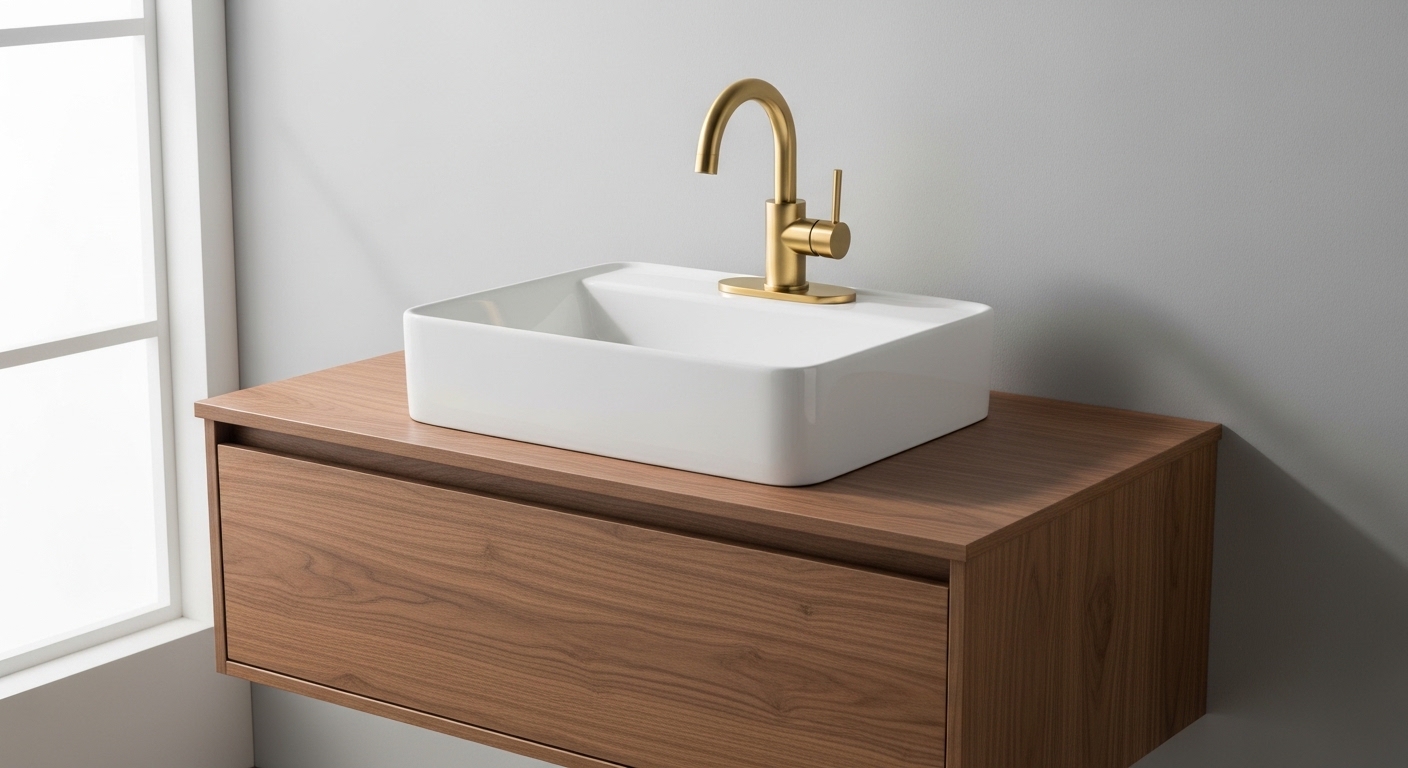
If you’ve just bought a beautiful above-counter bowl and now you’re staring at your vanity wondering how to make a tall faucet fit cleanly, a vessel sink faucet with deck plate is almost always the right answer. The faucet gives you the extra height a raised bowl needs, and the deck plate hides any mounting holes you don’t want to see. It’s a small part that solves a very common, very annoying problem — and getting it right takes about five minutes of planning before you buy.
I’ve installed and specified these across hundreds of bathroom builds, so below I’ll walk you through exactly when you need the deck plate, what height to buy, how the finishes compare, and how to install it without cracking your countertop. Let’s get into the real questions people actually ask.
What exactly is a deck plate, and why does a vessel faucet need one?
A deck plate is a flat oval or rectangular base — also called an escutcheon — that sits under your faucet and covers unused or oversized holes in the countertop. A vessel faucet “needs” one when your vanity has a standard 3-hole drilling (common on prefab granite and older tops) but the faucet itself only uses one hole. Without the plate, you’d be looking at two empty holes on either side of your faucet.
Here’s the thing most people don’t realize: many vessel faucets are technically single-hole faucets. They’re built tall and slim to reach over a bowl that sits on top of the counter rather than dropping into it. So if your countertop was drilled for a widespread or centerset faucet (holes 4 or 8 inches apart), a single-hole vessel faucet leaves gaps. The deck plate bridges that 4-inch or 8-inch spread and gives you a finished, intentional look.
The deck plate also adds real stability. A tall faucet has more leverage on it every time you push the handle back, and a wider base plate spreads that force across the counter instead of concentrating it on one thin mounting nut underneath. On a thin vessel bowl or a delicate stone top, that matters.
Do I actually need the deck plate if my vanity has only one hole?
No — if your countertop or vessel bowl is drilled for a single hole and nothing else, you can skip the deck plate entirely and mount the faucet directly. The plate is optional in that case and purely cosmetic. Many quality vessel faucets ship with the deck plate as a removable accessory precisely for this reason: install it for a 3-hole counter, leave it off for a clean single-hole install. Check the box before you assume you need it.
How tall should a vessel sink faucet with deck plate be for my bowl?
As a rule, your faucet’s spout should clear the top rim of the vessel bowl by at least 2 inches, and the spout should reach far enough toward the center of the bowl that water lands near the drain — not against the front wall where it splashes back at you. For a typical vessel bowl that stands 4–6 inches tall, that means a faucet with a total height around 11–13 inches and a spout reach of 5–6 inches.
Measure two things before buying: (1) the height of your vessel bowl from the counter to its rim, and (2) how far the bowl’s center sits from where the faucet mounts. Then match those to the faucet’s spec sheet. The single most common vessel-faucet mistake is buying one that’s too short — water pours down the inside wall of the bowl and splashes everywhere.
- Shallow bowl (3–4 in tall): faucet total height 9–11 in works fine.
- Standard bowl (4–6 in tall): aim for 11–13 in total height.
- Tall or deep bowl (6+ in): you’ll want 13–16 in, or a wall-mounted faucet instead.
- Spout reach: at least 4.5 in so the stream lands over the drain, not the rim.
What’s the difference between a vessel faucet and a regular bathroom faucet?
A vessel faucet is simply taller. A standard bathroom faucet is built for a sink that’s dropped into or under the counter, so its spout sits low — usually 4–6 inches high. A vessel faucet has to reach over a bowl that’s sitting up on the surface, so it’s typically 10–16 inches tall. Everything else — the valve, the ceramic disc cartridge, the supply connections — works the same way. Don’t try to use a standard-height faucet on a vessel bowl; the spout will sit too low to clear the rim.
Which finish should I pick, and how do the popular ones compare?
For a vessel setup, pick the finish that matches your drain, your cabinet hardware, and any nearby shower fixtures — the deck plate makes the faucet a visual focal point, so consistency reads as intentional. Brushed/matte finishes hide water spots and fingerprints best, which matters on a fixture people touch constantly. Here’s how the common options stack up in real bathrooms:
| Finish | Best for | Hides spots/prints | Upkeep | Vibe |
|---|---|---|---|---|
| Matte Black | Modern, white or wood vanities | Excellent | Low — wipe with damp cloth | Bold, contemporary |
| Brushed Gold / Champagne Bronze | Warm modern, glam bathrooms | Very good | Low | Warm, upscale |
| Brushed Nickel | Transitional, everyday use | Very good | Low — very forgiving | Neutral, safe |
| Chrome | Budget, bright bathrooms | Poor — shows everything | Higher — needs frequent wiping | Clean, classic |
| Oil-Rubbed Bronze | Traditional, rustic vanities | Excellent | Low | Warm, vintage |
If you’re torn, brushed nickel and matte black are the two most forgiving choices for a busy bathroom. For a warmer, more designer look, brushed gold has taken over in 2026 — if you’re leaning that way, our guide to the best bathroom faucet gold brushed finish for a modern vanity breaks down the exact shades and how they wear over time. And whatever finish you choose, make sure the deck plate matches the faucet and the drain — a mismatched pop-up drain is the detail that quietly ruins an otherwise great vessel setup.
Does the deck plate finish have to match the faucet exactly?
Yes — buy them as a set or from the same product line so the finish, sheen, and undertone match. This is more important than people think. “Brushed nickel” from two different brands can have visibly different warmth, and because the deck plate sits right under the faucet, any mismatch is impossible to hide. The safest move is to buy a vessel faucet that ships with its own matching deck plate, so you know the coating and undertone are identical.
How do I install a vessel sink faucet with deck plate without cracking the counter?
Install it in this order: mount the drain and bowl first, dry-fit the deck plate and faucet, then connect water below. The key to not cracking anything is snugging the mounting hardware by hand plus a gentle quarter-turn — never wrench it down hard against stone or ceramic. Here’s the full sequence:
- Shut off the water at the supply valves under the vanity and open the old faucet to release pressure.
- Set the deck plate over the mounting holes, usually with a rubber or foam gasket underneath to protect the counter and seal out water.
- Feed the faucet’s shank and supply lines down through the plate and the center hole.
- Hand-tighten the mounting nut from below, then add just a light snug with a basin wrench — stop as soon as it’s firm. Over-tightening is the #1 cause of cracked vessel bowls and stone tops.
- Connect the supply lines to the shut-off valves. If your valve spacing is awkward, a supply-line adapter or faucet supply line tee can save you a trip to the hardware store.
- Turn the water back on slowly, run hot and cold, and check every connection for drips before you walk away.
The whole job takes most DIYers 30–45 minutes. If you’ve never done a faucet before, the general technique is nearly identical to a drop-in — our step-by-step on how to properly install a faucet without calling a plumber covers the supply-line and mounting-nut basics that carry straight over to a vessel install.
What size hole do I need for a vessel faucet with a deck plate?
Most vessel faucets need a single 1.25 to 1.375 inch (32–35 mm) diameter mounting hole — the standard faucet hole size. The deck plate itself doesn’t require its own hole; it simply rests on top of the counter and covers whatever’s already drilled. So if your top has one hole, or three holes at 4-inch (centerset) or 8-inch (widespread) spacing, a deck plate rated for that spread will cover it. Just confirm the plate’s length is long enough to reach across your specific hole spacing before buying.
Vessel faucet with deck plate vs. wall-mounted vessel faucet — which is better?
Choose the deck-mounted faucet with a deck plate for almost every retrofit; choose a wall-mounted faucet only when your bowl is very tall or you want a spa-like, minimalist look and you’re comfortable opening the wall. The deck-mount is cheaper, far easier to install, and works with your existing plumbing. A wall-mount requires the valve and spout to be plumbed inside the wall at the right height for your specific bowl — get that height wrong and it’s a demolition job to fix.
| Factor | Deck-mount + deck plate | Wall-mounted |
|---|---|---|
| Install difficulty | Easy — DIY in under an hour | Hard — in-wall rough-in required |
| Works with existing counter holes | Yes — plate covers extras | N/A — mounts in wall |
| Best for tall/deep bowls | Good up to ~6 in bowls | Best — perfect for deep bowls |
| Countertop cleaning | Wipe around base | Fully clear counter — easiest |
| Cost & flexibility | Lower cost, easy to swap | Higher cost, permanent |
For 90% of homeowners upgrading to a vessel bowl, the deck-mounted faucet with deck plate wins on cost, simplicity, and flexibility. Save the wall-mount for new construction or a full remodel where you control the plumbing from the start.
What should I look for in quality — and what does it cost?
Look for a solid brass body, a ceramic disc cartridge, a lead-free waterway, and a real spec sheet listing height and reach — those four things separate a faucet that lasts 15 years from one that drips in 18 months. Expect to pay roughly $60–$120 for a solid mid-range vessel faucet with matching deck plate, $120–$250 for premium finishes and heavier brass, and under $50 for thin zinc-body units you’ll likely replace within a few years.
- Body material: solid brass resists corrosion far better than zinc alloy. Heft is a good clue — a quality vessel faucet feels heavy for its size.
- Cartridge: a ceramic disc valve is the standard for smooth, drip-free operation over years of use. If yours ever does start to drip, the fix is usually a cheap cartridge swap, similar to diagnosing a dripping widespread faucet.
- Lead-free certification: look for compliance with the U.S. Safe Drinking Water Act (≤0.25% weighted lead) and NSF/ANSI 61 & 372 for drinking-water safety.
- Flow rate: most bathroom faucets are capped at 1.2 GPM; a WaterSense-labeled model saves water without feeling weak.
- Warranty: a strong finish-and-function warranty tells you the maker trusts their own coating.
One more practical tip: if you live with hard water, the tall exposed spout of a vessel faucet will show lime scale faster than a low-profile one. A quick weekly wipe keeps it bright — and for stubborn buildup, our rundown of the best hard water cleaner for a faucet with lime buildup will keep any finish looking new.
FAQ
Can I use any single-hole faucet as a vessel faucet if I add a deck plate?
Only if it’s tall enough. The deck plate handles the mounting-hole cosmetics, but it does nothing for height. A standard single-hole bathroom faucet sits 4–6 inches tall and will pour water against the inside wall of a raised bowl. You specifically need a vessel-height faucet (typically 10–16 inches) with enough spout reach to clear the rim and land water over the drain.
Will a deck plate cover both 4-inch centerset and 8-inch widespread holes?
Not with one size. Deck plates are made to a specific length. A centerset deck plate (about 4 inches wide) covers holes 4 inches apart; a widespread-length plate (roughly 8–12 inches) covers holes spaced 8 inches apart. Measure the distance between the centers of your outer holes first, then buy a plate rated to span at least that distance.
Does a vessel faucet with deck plate come with the drain?
Usually not, but check the listing. Vessel faucets and drains are often sold separately because vessel bowls typically use a non-overflow pop-up or grid drain that must match the bowl. Buy the drain in the same finish as the faucet and deck plate so all three coordinate. A few kits bundle all three — those save you the matching headache.
How do I stop water from splashing out of my vessel bowl?
Splashing almost always comes from one of two things: a faucet that’s too tall for a shallow bowl (water falls too far), or a spout that aims at the front wall instead of the drain. Match your faucet height to your bowl depth using the numbers above, aim for a spout that lands water near the center drain, and if the stream is too forceful, add or clean the aerator to soften the flow.
Is a vessel sink faucet with deck plate hard to remove later?
No — it comes off the same way it went on. Shut off the water, disconnect the supply lines, loosen the mounting nut underneath, and lift the faucet and deck plate off the counter. Because the deck plate covers the existing holes, you can later swap to a different single-hole faucet or a full centerset/widespread setup without re-drilling. That flexibility is one of the quiet advantages of going deck-mounted.
What’s the ideal height for a vessel faucet over a 5-inch-tall bowl?
For a bowl that stands about 5 inches tall, target a faucet with a total height around 12–13 inches and a spout reach of 5 inches or more. That gives you roughly 2 inches of clearance above the rim plus a stream that lands over the drain. Always cross-check against the faucet’s published spec sheet, since where the spout actually bends matters as much as the total height number.
Author note: This guide was written by the vigacc product team, who specify and pressure-test bathroom faucets for a living. We’ve fitted vessel faucets across everything from prefab granite vanities to custom stone tops, and the height-and-hole advice here comes from real installs, not spec sheets alone.
About vigacc: vigacc (viga.cc) is a manufacturer and retailer of faucets and bathroom fixtures. Our vessel faucets are built with solid brass bodies and ceramic disc cartridges, tested to NSF/ANSI 61 & 372 lead-free standards and WaterSense flow guidelines, and backed by a manufacturer warranty on finish and function. We share what we’d tell a friend — even when that means telling you which faucet you don’t need.
WeChat
Scan the QR Code with WeChat