 iVIGA Faucet Manufacturer & Factory

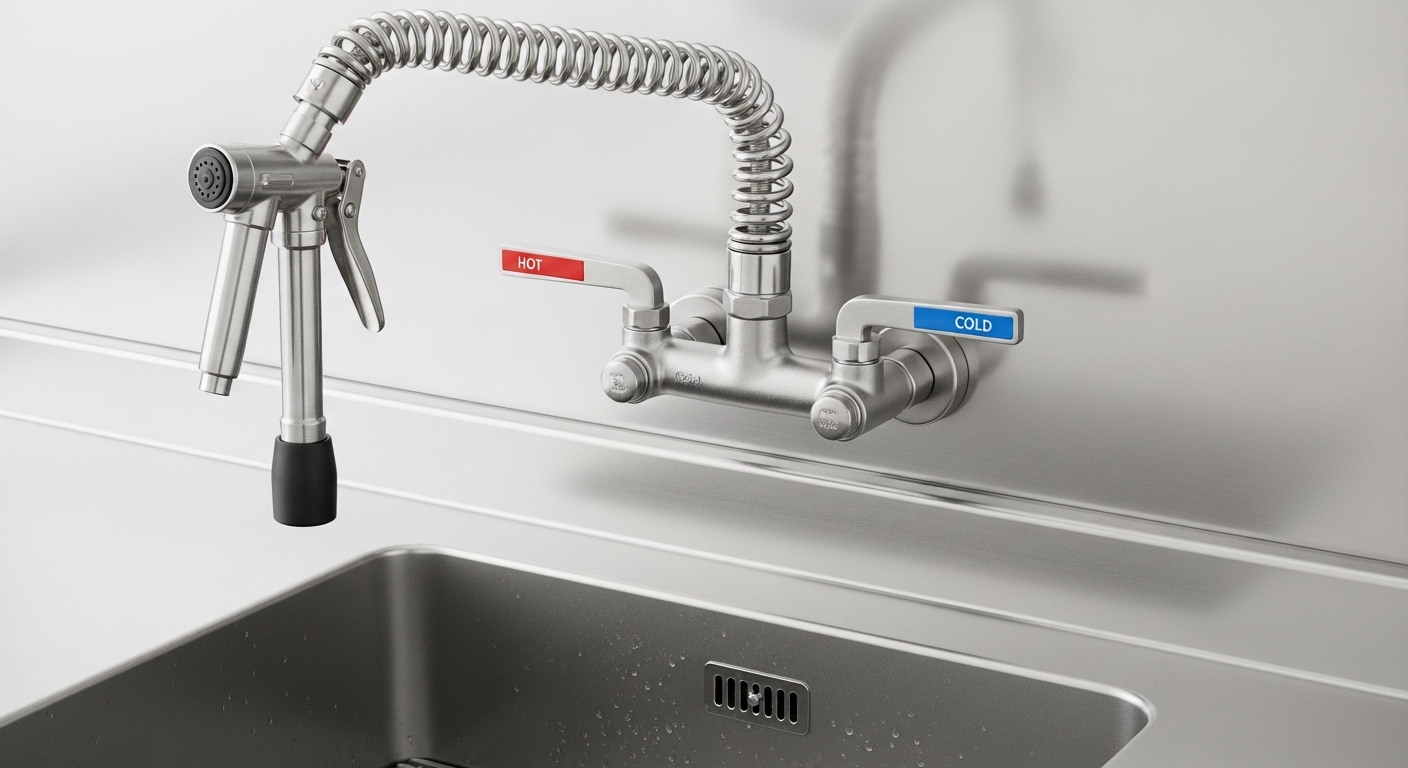
If you are kitting out a restaurant, school, gym, or warehouse and need a tap that bolts to the wall above a utility basin, a wall mount utility faucet with sprayer is almost always the right call. It keeps the deck of your mop sink or scrub basin clear, gives you a high-arc spout for filling buckets, and adds a spray function for rinsing mops, boots, produce bins, or anything else that won’t fit under a fixed spout. This guide walks through what actually matters when you buy one for commercial duty — flow rates, valve type, spread, certifications, and the real-world differences between a coil-spring pre-rinse and a simple pull-down sprayer — so you don’t overpay for the wrong fixture.
At vigacc, we manufacture and wholesale commercial-grade faucets out of Kaiping, China, and we ship utility and pre-rinse units to distributors, contractors, and facility buyers worldwide. Below is the same advice we give buyers placing bulk orders.
What exactly is a wall mount utility faucet with sprayer, and where is it used?
It’s a faucet that mounts to the wall (not the sink deck or countertop) and pairs a standard spout with a separate spray head — either a flexible pull-out hose or an overhead coil-spring pre-rinse arm. You’ll find them above mop/service sinks, in janitor closets, in commercial kitchens for pot-filling and pre-rinsing dishes, in laundry rooms, garages, breweries, salons, vet clinics, and anywhere a basin takes heavy abuse and needs both a fill stream and a directed spray.
The wall-mount format exists for a practical reason: utility basins are often deep, free-standing, or floor-mounted with no deck to drill. Bolting the faucet to the wall puts the controls at a comfortable height, keeps them out of the splash zone, and makes the whole thing easier to wipe down. The two supply inlets are typically spaced 8 inches apart on center, matching the rough-in on most commercial service-sink faucets. If you’re weighing deck-mount versus wall-mount layouts in general, our breakdown of why we choose 8-inch faucets covers the spread math in more detail.
Coil-spring pre-rinse vs. pull-out sprayer: which sprayer style should you buy?
Choose a coil-spring pre-rinse for heavy dish and pot rinsing with high pressure; choose a pull-out or pull-down hose sprayer for general utility, bucket filling, and tight spaces. The pre-rinse gives you a powerful, concentrated jet on a tall spring arm; the pull-out trades some reach and pressure for a lower profile and a gentler stream.
Here’s the plain-English difference. A pre-rinse unit has that tall, springy stainless coil with a squeeze-trigger spray valve hanging at the end — the thing you see in every restaurant dish pit. It runs at higher pressure (often 1.42–1.75 GPM at the spray head but with a very forceful jet) and is built to blast food off plates before they hit the dishwasher. A pull-out sprayer integrates the spray head into the spout itself; you grab it and pull a hose out. It’s quieter, shorter, and better suited to mop sinks and prep basins where you don’t need fire-hose pressure.
| Feature | Coil-Spring Pre-Rinse | Pull-Out / Pull-Down Sprayer |
|---|---|---|
| Best for | Dish pits, pot rinsing, high-volume kitchens | Mop sinks, prep basins, laundry, garages |
| Spray pressure | Very high, concentrated jet | Moderate, adjustable stream/spray |
| Spout height | Tall (18″–24″+), needs clearance | Compact, fits under low shelves |
| Typical flow | 1.42–1.75 GPM at head | 1.5–2.2 GPM |
| Hose reach | Fixed arm + flexible spray valve | 20″–30″ pull-out hose |
| Price range (commercial) | $120–$350 | $70–$200 |
If your basin is going under a wall cabinet or low shelf, measure your vertical clearance before you fall in love with a pre-rinse — those coil arms are tall. For a deep floor-mounted mop sink in an open janitor closet, the pre-rinse height is a non-issue and the extra pressure is a gift.
What flow rate and pressure do I actually need for a commercial utility sink?
For most commercial utility and mop sinks, target a 1.5–2.2 GPM spout flow for fast bucket filling, with a spray head rated around 1.42–1.75 GPM. Federal limits cap most lavatory faucets at 0.5 GPM, but utility and pre-rinse fixtures fall under different rules and are allowed higher flow because they’re task fixtures, not hand-washing fixtures.
Why flow matters: a janitor filling a 5-gallon mop bucket cares about seconds, not aesthetics. At 2.2 GPM, a 5-gallon bucket fills in roughly 2.3 minutes; drop to 1.0 GPM and you’ve doubled that wait, multiplied across every shift. So for utility duty you generally want the highest compliant flow you can get. That said, check your local code and your water pressure — most of these faucets are rated for 20–80 PSI, and a vacuum breaker on the spray hose is frequently required by plumbing code to prevent backflow into the potable supply.
- Spout flow: 1.5–2.2 GPM is ideal for bucket and pot filling.
- Spray head: 1.42–1.75 GPM gives a forceful rinse without wasting water.
- Operating pressure: confirm the unit handles 20–80 PSI; most commercial buildings sit in this range.
- Vacuum breaker: look for an atmospheric or built-in backflow preventer — it’s often code-mandated on hose sprayers.
- Hot + cold: dual inlets with a mixing handle let you temper water for cleaning and degreasing.
Brass, stainless, or zinc — what material holds up in heavy commercial use?
For commercial longevity, buy solid brass for the faucet body and stainless steel for the spring arm and spray components; avoid zinc-alloy (pot metal) bodies on anything that sees daily abuse. Brass resists corrosion and handles repeated thermal cycling, while stainless springs and braided hoses survive the constant flexing a sprayer endures.
The cheapest utility faucets cut costs by using zinc alloy castings under a thin chrome plate. They look fine on day one, but in a wet, chemical-heavy environment — bleach, degreasers, hot water — zinc pits and the plating flakes within a year or two. A solid-brass body with a ceramic-disc cartridge is the workhorse standard; ceramic discs give you a clean quarter-turn shutoff and resist the grit and mineral scale that destroy old rubber-washer valves. We dig into why pros and even homeowners gravitate to this build quality in our piece on why commercial faucets are chosen by home kitchens.
On finishes: most commercial utility faucets ship in polished chrome or brushed/satin stainless for a reason — they’re durable, easy to sanitize, and hide water spots better than delicate decorative coatings. Save the fancy finishes for the front-of-house lavatories.
What certifications and standards should a commercial utility faucet meet?
For commercial installation in North America, your faucet should carry cUPC or UPC certification (plumbing code compliance), NSF/ANSI 61 and 372 (lead-free and material safety), and ideally an ASME A112.18.1 listing. If it goes anywhere food is handled, NSF listing is effectively non-negotiable for passing a health inspection.
These aren’t just stickers. UPC/cUPC means the fixture meets the Uniform Plumbing Code your inspector enforces. NSF/ANSI 372 certifies the wetted surfaces meet the federal “lead-free” definition (≤0.25% weighted average lead content). NSF/ANSI 61 covers the health effects of materials in contact with drinking water. Skip these and you risk a failed inspection, a torn-out faucet, and a re-order — far more expensive than buying certified the first time. We explain the certification alphabet soup in plain terms in our guide to kitchen faucet UPC certification and why it matters before you buy.
A quick certification checklist for buyers:
- cUPC / UPC — plumbing code listing (required in most US/Canada jurisdictions).
- NSF/ANSI 61 & 372 — lead-free and material safety, essential for food-service.
- ASME A112.18.1 / CSA B125.1 — performance and durability standard for plumbing fittings.
- Warranty — look for at least a limited commercial warranty on the body and cartridge.
How hard is it to install a wall mount utility faucet, and can I DIY it?
If your rough-in already has two wall stub-outs at 8-inch centers, swapping in a wall mount utility faucet with sprayer is a 30–60 minute job for anyone comfortable with a wrench and plumber’s tape. If you’re adding a basin to a wall with no plumbing, that’s a job for a licensed plumber because it involves opening the wall and tying into supply lines.
The straightforward case: shut off the water, unthread the old faucet, clean the threads on the wall stub-outs, wrap them with PTFE (plumber’s) tape, thread on the new faucet’s coupling nuts, and snug them with a wrench — don’t overtighten and crack the casting. Mount any wall bracket for the spout, attach the spray hose and vacuum breaker per the instructions, then turn the water back on and check every joint for drips. Run both hot and cold for a minute to flush debris before you trust the spray valve.
A few field tips that save callbacks:
- Confirm your inlet spread before ordering — 8-inch centers are standard, but some service faucets use different spacing.
- Use a vacuum breaker if the spray hose can reach below the flood rim of the basin; it’s usually required.
- Check the spout reach so the stream lands in the basin, not on the rim or the floor.
- For a high-arc pre-rinse, verify ceiling/shelf clearance for that tall coil arm.
If you’re choosing a faucet primarily for commercial bathrooms rather than back-of-house utility work, the spout geometry trade-offs are a little different — our look at the centerset gooseneck faucet for commercial bathrooms covers that side of the catalog.
How much should I budget, and is a sprayer worth the extra cost?
Expect to spend $70–$200 for a quality pull-out wall mount utility faucet and $120–$350 for a stainless coil-spring pre-rinse, in single-unit commercial pricing; bulk/wholesale pricing runs lower. The sprayer is almost always worth it — the time saved rinsing buckets, mops, and equipment pays back the small premium within weeks in a busy facility.
Think of the sprayer not as a luxury but as a labor multiplier. A fixed spout forces you to drag heavy items under it; a sprayer comes to the item. For mop sinks, the spray lets you blast out the basin and rinse mop heads without splashing the whole closet. For prep kitchens, it pre-rinses pots and pans in seconds. The only time you can skip the sprayer is a pure bucket-fill station where nothing ever needs directed rinsing — and even then, most buyers regret going without.
If you’re buying for a kitchen that does heavy dish duty, you may also be weighing two-handle pull-down kitchen units; our pull-down kitchen faucet with two handles buyer’s guide compares those spray mechanisms in depth.
Quick buyer’s summary
For a commercial utility sink that sees daily abuse, the sweet spot is: solid-brass body, ceramic-disc cartridge, 8-inch centers, stainless spray components, vacuum breaker, cUPC + NSF certification, and a spray style matched to your task — pre-rinse for dish pits, pull-out for mop and prep basins. Get those right and the faucet outlives the renovation.
FAQ
Can I use a wall mount utility faucet with sprayer for hand washing in a food-service area?
You can use it for general washing, but a dedicated hand-wash sink with a separate compliant lavatory faucet is usually required by health code in food-prep areas. Utility faucets run at higher flow rates than the 0.5 GPM lavatory limit, so check your local jurisdiction — most codes require a designated hand sink that’s separate from the utility/mop sink.
What size are the wall connections on most commercial utility faucets?
The vast majority use 8-inch (200mm) center-to-center inlets with 1/2-inch NPT threaded connections. Always confirm your existing rough-in spacing before ordering, because a mismatch means new plumbing or an adapter kit.
Do I need a vacuum breaker on the sprayer?
In most North American jurisdictions, yes — if the spray hose can reach below the flood rim of the basin, a vacuum breaker (backflow preventer) is required to stop contaminated water from siphoning back into the potable supply. Many commercial pre-rinse and utility faucets include one built in; verify before installing.
Will a pre-rinse coil-spring faucet fit under a wall cabinet?
Often not — coil-spring pre-rinse arms stand 18 to 24-plus inches tall and need open vertical clearance. If your basin sits under a shelf or cabinet, measure first and choose a compact pull-out sprayer instead, which keeps a low profile.
Is stainless steel or chrome better for a commercial utility faucet?
Both perform well; the bigger factor is the underlying body material. A solid-brass body with either a chrome or brushed-stainless finish will outlast a zinc-alloy body with any finish. Brushed stainless hides water spots and scratches better in a high-traffic utility space, while polished chrome is easier to wipe to a clean shine.
How long should a commercial utility faucet last?
A solid-brass, ceramic-disc unit installed correctly should give 7–15 years of commercial service, with the spray hose and cartridge being the most likely wear parts. Buy a model with replaceable cartridges and an available spray-hose kit so you can rebuild rather than replace.
About the author: This guide was written by the product team at vigacc, faucet manufacturers and wholesalers based in Kaiping, China — the heart of China’s plumbing-hardware industry. We design, cast, and pressure-test commercial and residential faucets, and we supply utility, pre-rinse, and pull-out units to distributors and contractors internationally.
Why trust vigacc: Every commercial faucet we ship is built on solid-brass bodies with ceramic-disc cartridges, pressure-tested before it leaves the line, and produced to meet cUPC/UPC and NSF/ANSI 61 & 372 lead-free standards. Our utility faucets carry a limited commercial warranty on the body and cartridge. Learn more at why customers choose us for wholesale faucet needs.
WeChat
Scan the QR Code with WeChat